

Reflection in AI Agents: The Habit That Separates Reliable Systems from Demos
Reflection is an AI agent deliberately checking its own work before it ships: critique loops, self-verification and checker agents. How it works, why it cuts error rates, what it costs, and its honest limits.
Think about the best professional you have ever worked with. Whatever their field, they shared one habit with every other excellent professional: they checked their own work before handing it over. The email got re-read, the numbers got sanity-checked, the dish got tasted before it left the kitchen.
Now recall the defining flaw of AI systems: they fail politely and plausibly, producing output that looks right but is not, at full confidence, without the flicker of doubt a human shows when unsure. Put those two observations together and you have discovered reflection, the practice of making an AI agent deliberately check its own work before anything ships, and arguably the single highest-leverage reliability technique in the whole agentic toolkit.
This article covers what reflection actually is, the three forms it takes in production systems, why it works despite an obvious objection, what it costs, and where its limits genuinely are. It is the least flashy chapter of our agent anatomy series and, for anyone who cares about the [40% project failure statistic], possibly the most important.
What Is Reflection, in Plain Terms?
Reflection is a built-in review step: after the agent produces something (an answer, a plan, an action result), the system pauses and evaluates it against explicit criteria before proceeding. Is every claim supported by the sources? Does the total match the line items? Does this reply follow the refund policy? Did that tool call actually achieve what it was for? If the check fails, the agent revises and tries again; if it passes, the work proceeds.
The analogy: the chef tasting the dish before it leaves the pass. Not a different skill from cooking, and not a guarantee (a chef with a cold misses things), but the single cheapest quality control in the kitchen, applied at the exact moment fixing is still free. Restaurants that skip the tasting ship their mistakes to the dining room; agents without reflection ship theirs to your customers.
Reflection is the deliberate, designed upgrade of the feedback loop from our [anatomy article]: the eyes, pointed inward on purpose, with a checklist.
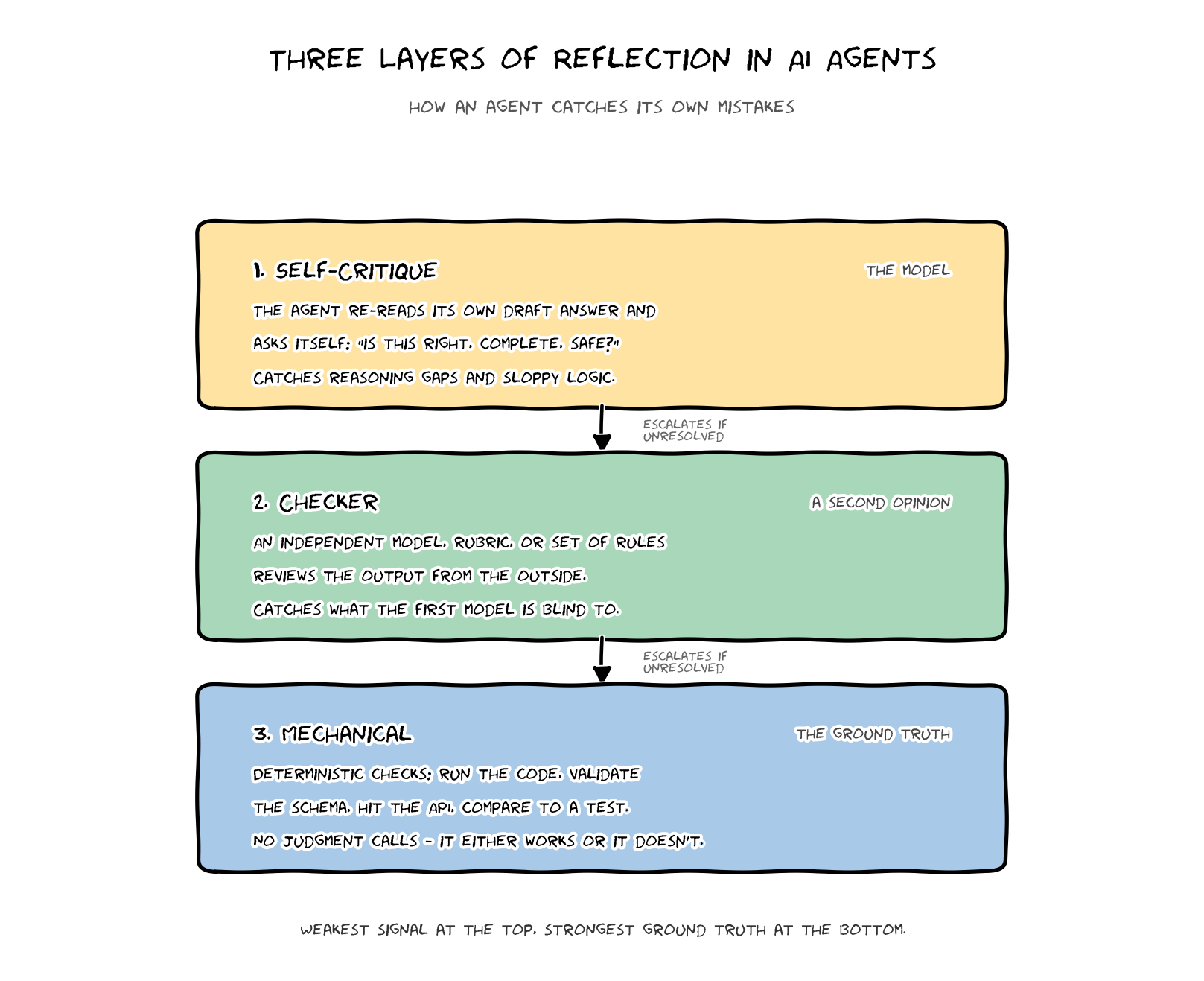
The Three Forms Reflection Takes
Form 1: Self-critique (taste your own dish). The same agent, after drafting, is prompted to review its own output against criteria: re-read this reply, verify each factual claim against the retrieved documents, check the policy conditions, list any problems, then revise. It sounds too simple to work, and the objection is obvious: if the model made the error, why would it catch the error?
The honest answer: because generating and evaluating are different tasks, and models are meaningfully better at the second. Spotting an unsupported claim in a draft is easier than never making one, for machines as for people (every writer knows editing a page beats writing a perfect one). Self-critique does not catch everything, but it reliably catches a worthwhile share, at the cost of one extra thinking pass.
Form 2: The checker agent (a second taster). A separate agent, with different instructions and often a different model, reviews the maker's work against a checklist before it ships: the maker-checker pattern from [Multi-Agent Systems]. Separation matters: the checker was not the author, carries no attachment to the draft, and is prompted purely to find problems. This is the production workhorse: verify every claim against sources, confirm policy compliance, flag anything unsupported, block anything failing.
Form 3: Verification against reality (check the till, not the memory). The strongest form is not asking the model at all, but checking outputs against ground truth wherever ground truth exists: run the calculation independently, confirm the API said "created" and the record actually exists, match the quoted price against the price list. Deterministic checks are cheap, incorruptible and immune to shared model blind spots. The design rule that follows: verify mechanically wherever you can, reflect linguistically where you cannot.
Production systems layer all three: self-critique on everything (nearly free), checker agents on consequential outputs, mechanical verification wherever a fact can be tested, and [human approval] holding the gates beyond all of it.
Why Should a Business Care?
Because reflection attacks the exact failure mode that kills projects. The plausible-but-wrong output is the signature failure of agentic AI: it is what erodes trust one polite error at a time until someone cancels the line item ([the 40% article] traces this arc in detail). Reflection is the counter-habit: the system that doubts itself on schedule so your customers never have to.
Because the economics are lopsided. A reflection pass costs one or two extra model calls: pennies. The errors it catches cost embarrassment, rework, refunds and trust: pounds to unquantifiable. In our experience, adding a checker to an existing agent is the single best reliability-per-pound upgrade available, which is why the [multi-agent article] calls it the gateway drug.
Because it changes what monitoring finds. Weekly transcript reviews (the [governance] habit) on an unreflective agent find raw errors; on a reflective one, they find the checker's catch log: what almost shipped and why. That log is gold: it tells you which criteria earn their keep, which document keeps misleading the maker, and where the next improvement lives. Reflection turns quality from a mystery into a dataset.
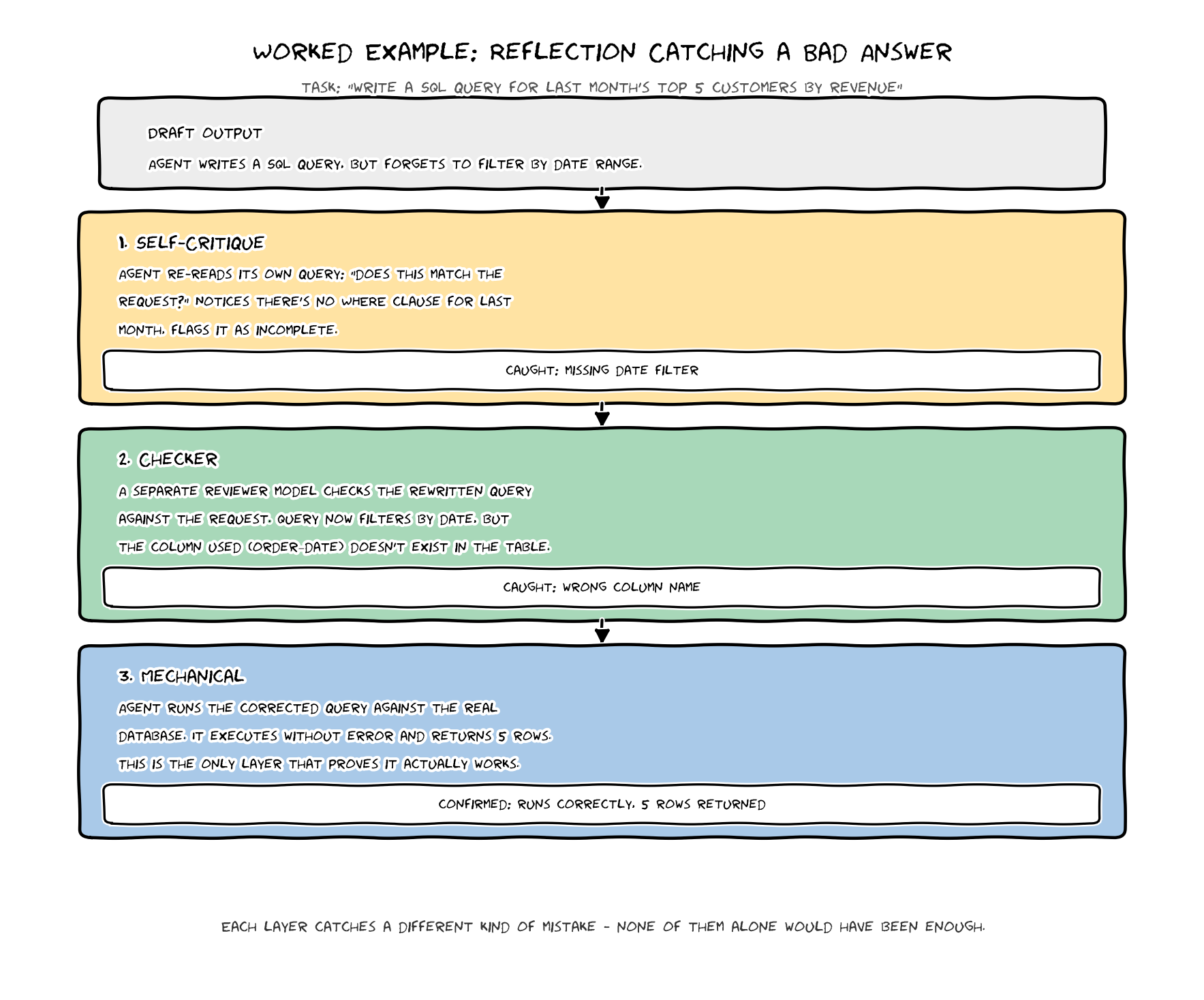
A Worked Example: The Quote That Did Not Go Out
A trade supplier's quoting agent drafts a quote for a customer: 40 units, bulk pricing, delivery to Singapore.
The draft looks perfect. The reflection layer runs anyway. Self-critique passes: the reply is clear, polite, complete. The mechanical checks run: unit price matches the current price list (pass), total arithmetic (pass), delivery surcharge for Singapore... fail: the draft used the mainland rate. The checker agent, prompted with the pricing policy, confirms: surcharge missing, quote understated by $38.
The agent revises, re-checks (pass), and the corrected quote ships, thirty seconds later than the wrong one would have. Nobody noticed, which is the entire point. Multiply by every quote, every week: the unreflective version of this agent is quietly training customers that quotes need double-checking; the reflective one is quietly building the opposite reputation. Same model, same tools, same [memory]. One habit apart.
Building the Checklist: What Actually Goes on It
Since the checklist does the work, here is how to write one that earns its tokens, using a support-reply agent as the running example.
Start from your incidents, not your imagination. The best reflection criteria are your last twenty errors, generalised: if wrong prices have shipped, "verify every price against the retrieved price list" goes on the list; if tone has wobbled, "no promises of outcomes, no legal language" joins it. A checklist written from real failures beats a comprehensive-sounding one written from theory, and it stays short, which matters because every criterion costs checking time.
Make each criterion decidable. "Is this reply good?" invites agreeable mush. "Does every factual claim cite a retrieved source? Is the refund amount within policy table 2? Is there exactly one clear next step for the customer?" Each is answerable yes or no, which is what makes the critique honest.
Split by check type. Mechanical criteria (prices, totals, thresholds, record-existence) go to deterministic code, always. Judgment criteria (tone, completeness, policy interpretation) go to the linguistic checker. Mixing them wastes the strengths of both.
Include the escalation criterion. Every checklist's last line: "if any check fails twice, or if confidence is low, route to the human queue with this checklist's results attached." The checklist that cannot fail gracefully is theatre.
Review the checklist quarterly against the catch log. Criteria that never catch anything are candidates for retirement; error types appearing in the wild but not on the list are the next additions. The checklist is a living document with the same maintenance rhythm as every other [governance] boundary.
A good agent checklist fits on half a page and reads like the induction sheet for a careful employee, which is exactly what it is.
What Are the Limitations?
Shared blind spots are real. Self-critique by the same model can miss what the model structurally misses; a checker on the same model family helps less than one on a different family. This is why mechanical verification outranks linguistic reflection wherever it is available, and why humans hold the final gates on the consequential.
Reflection can be theatre. A vague "review your answer" prompt produces vague approval: models are agreeable by default. Effective reflection is specific: explicit criteria, claim-by-claim verification against sources, named policies to check. The checklist, not the pause, does the work: exactly like human review.
Loops need budgets. Draft, critique, revise, critique... a perfectionist loop can circle, burning tokens on diminishing returns. Production builds cap revision rounds (two is common) and escalate to a human when the checker still objects, which is itself a useful signal: work the system cannot satisfy itself about is precisely the work a person should see.
Latency exists. Reflection adds seconds. For chat this is usually invisible; for high-frequency micro-decisions it may not be affordable, which is one more reason high-frequency rule-shaped work belongs on deterministic rails ([the hybrid stack] division of labour) rather than on reflective agents at all.
The Buyer's Reflection Questions
- "What checks run on output before it ships?" Specific criteria and mechanical verifications mean designed reflection; "the model is very accurate" means none.
- "Show me the catch log." What did reflection intercept last week? A real system has examples; the log's existence is the proof.
- "What happens when the check fails twice?" The right answer involves a human queue, not infinite retries or silent shipping.
- "Which checks are mechanical?" Prices, totals, record-existence, policy thresholds: the more verified against reality rather than opinion, the more you can trust the rest.
Frequently Asked Questions
What is reflection in AI agents? A designed review step where the agent's output is checked before it ships: by the agent critiquing its own work against explicit criteria, by a separate checker agent, or by mechanical verification against real data (prices, totals, records). It targets AI's signature failure: output that looks right but is not.
How can an AI catch its own mistakes? Didn't it make them? Generating and evaluating are different tasks, and models are better at the second: spotting an unsupported claim in a draft is easier than never writing one, for machines as for people. Self-critique catches a worthwhile share; separate checkers and mechanical verification catch progressively more.
Does reflection make AI agents slower and more expensive? It adds seconds of latency and pennies of extra model calls per output. Against the cost of shipped errors (rework, refunds, eroded trust), it is the most lopsided trade in agentic AI. The exception is high-frequency micro-decisions, which belong on deterministic rails anyway.
What is a checker agent? A second agent, separately instructed and ideally on a different model, that reviews the first agent's work against a checklist before anything ships: the maker-checker pattern. It is the cheapest meaningful upgrade to an existing agent and the standard entry point into multi-agent architecture.
Can reflection replace human review? It reduces what reaches humans and improves what they see, but it does not replace the gates on consequential actions: money, commitments, mass communication. The mature pattern is layered: mechanical checks, then AI reflection, then human approval where stakes justify it, per our [Human Approval] and [governance] guides.
Is reflection the same as AI reasoning or chain-of-thought? Related but distinct: chain-of-thought is thinking step by step while producing an answer; reflection is reviewing the produced answer before releasing it. Drafting carefully versus proofreading. Reliable systems do both, plus mechanical verification, plus human gates.
Should reflection run on every output or just the important ones? Layer it by stakes: lightweight self-critique on everything (one cheap pass), the full checklist with a checker agent on anything customer-facing or consequential, and mechanical verification wherever a fact is testable, always. High-frequency internal micro-outputs can run on spot-sampling instead: check one in twenty and let the [governance] weekly review read the samples. The design mirrors human quality control exactly: not every internal email gets proofread twice, but everything that leaves the building does.
How do I know if my agent's reflection is actually working? Three evidence streams: the catch log (what reflection intercepted, reviewed weekly; an empty log on an active agent means dead checks, not perfection), the escaped-error rate (what still reached humans or customers, trending down), and seeded tests (deliberately flawed inputs planted occasionally; each should be caught and logged). Together they answer the only question that matters: is the taster still tasting? Reflection you cannot evidence is reflection you should assume has quietly stopped.
The Takeaway
Reflection is the professional habit, installed in software: taste before serving, re-read before sending, check the total against the till. Three layers deep (self-critique, second taster, reality check), capped with revision budgets and a human queue for the stubborn cases.
It is the least glamorous component in the agentic toolkit and the one that most reliably keeps your business out of the failure statistics, because the error a customer never saw costs nothing and teaches everything. Ask any vendor one question and watch carefully: show me what your agent caught itself getting wrong last week. The good ones smile and open the log.
Bots and Brand Works builds single agents that earn their teams: maker-checker pairs, orchestrated specialists, full traces, honest per-outcome costs. If a multi-agent pitch has you wondering whether it is architecture or theatre, send it over and we will read the org chart for you.
Need Help Implementing AI?
Resources and Further Reading
- Agentic AI vs Workflow Automation: The 2026 Enterprise Guide
- Related: Agent Planning Explained [add internal link]
- Related: Why 40% of AI Agent Projects Fail [add internal link]
- Also in this series: What Is an AI Agent? · Multi-Agent Systems · Human Approval [add internal links]
- Reflexion paper (Shinn et al.):Click Here
- Anthropic: Building effective agents: Click Here