

How Much Does AI Automation Cost? An Honest Pricing Guide for Small Businesses
Real numbers for AI automation: what chatbots, AI agents and custom builds actually cost small businesses, what drives the price up or down, and how to spot an inflated quote.
Ask three agencies what AI automation costs and you will get three answers: "it depends," "book a call," and a number so wide it could describe a kitchen renovation or a house.
We understand why. Every business is different, quotes need scoping, and nobody wants to be held to a number from a blog post. But "it depends" is not useful when you are trying to decide whether this is a $50 experiment or a $15,000 commitment, and we think you deserve actual ranges before you book anyone's call, including ours.
So here they are: honest numbers, what moves them up and down, where the hidden costs live, and the questions that keep a quote honest. Prices below are in pounds, based on what we see in the market in 2026. Treat them as ranges to reason with, not promises, because your specifics genuinely do move the number. By the end you will know roughly what your project should cost before anyone tries to tell you otherwise.
What Are You Actually Paying For?
Before the numbers, a 60-second refresher on what is under the bonnet, because every line on an AI quote maps to a layer of what we call the [AI automation stack].
Think of it like a restaurant. The AI model (the chef) is rented per use. The connections to your tools (the waiters) are built or configured once. Memory, so the system knows your business, is set up once and hosted monthly. Coordination, safety locks and monitoring are built in during the project. Some of these are one-off build costs, some are monthly running costs, and confusing the two is the single most common way businesses misread quotes.
So every price below splits into two questions: what does it cost to build, and what does it cost to run each month?
The Numbers: Four Tiers of AI Automation
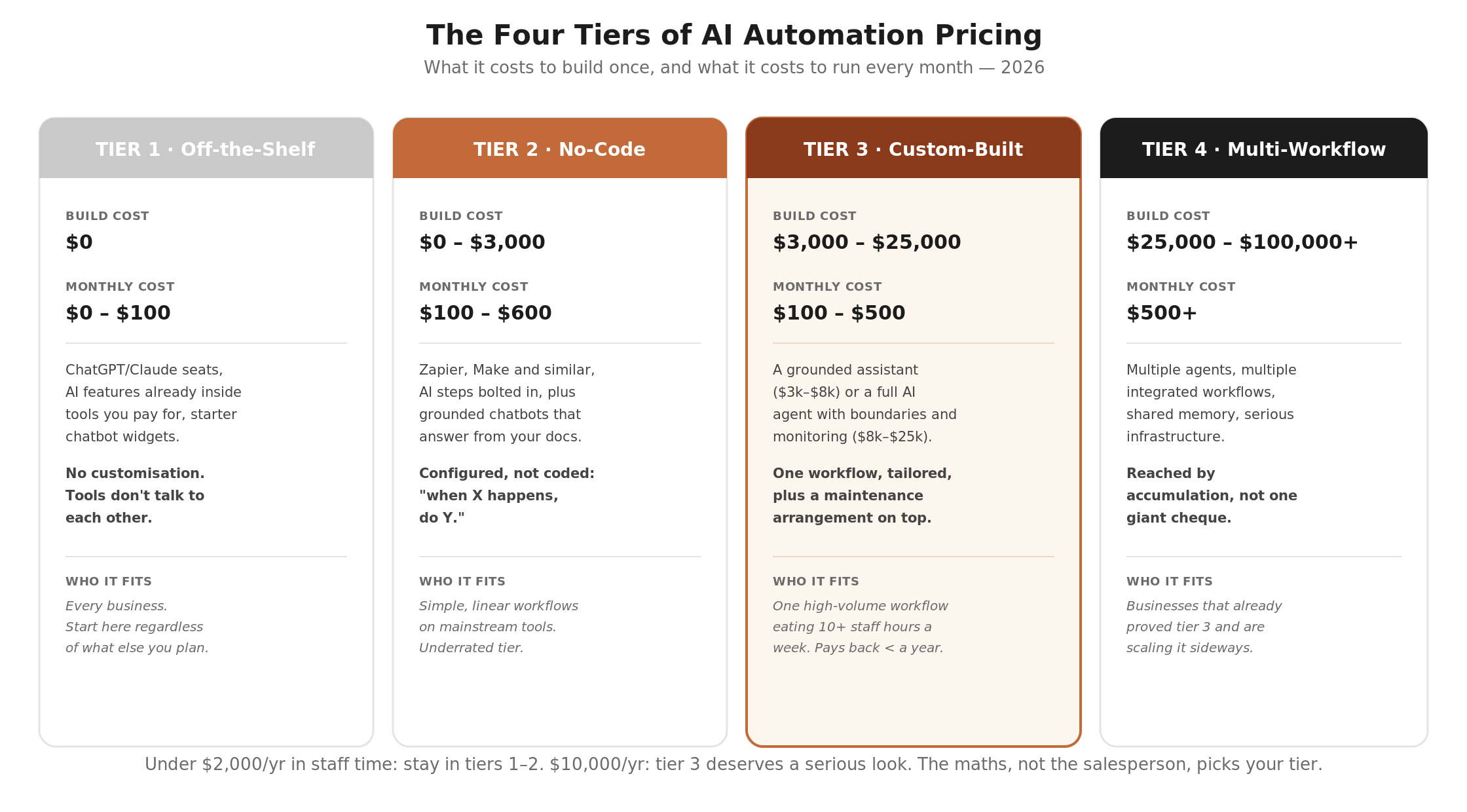
Tier 1: Off-the-shelf AI tools ($0 to $100 per month, no build cost)
This is ChatGPT or Claude subscriptions for your team, AI features already inside tools you pay for (your email marketing platform's AI writer, your CRM's summariser), and simple website chatbot products on starter plans.
No build cost, no developer, live today. The limit: nothing is customised to your workflows, and the tools do not talk to each other. This tier makes individuals faster; it does not automate processes.
Who it fits: every business. Genuinely, start here regardless of what else you plan.
Tier 2: Configured automation, no code ($100 to $600 per month, $0 to $3,000 setup)
Zapier, Make and similar platforms with AI steps bolted in, plus grounded chatbot products that answer from your documents. You (or a freelancer) configure rather than code: when a form is submitted, summarise it with AI, draft a reply, add a row to the sheet.
Setup, if you outsource the configuration, typically runs a few hundred to a few thousand pounds. Monthly costs are the platform subscriptions plus modest AI usage.
Who it fits: businesses with simple, linear workflows ("when X happens, do Y") and mainstream tools. This tier is underrated and quietly does the job for a lot of small businesses. Not sure whether fixed rules or reasoning AI fits your workflow? Our pillar guide, Agentic AI vs Workflow Automation, is that decision in full.
Tier 3: Custom-built single automation ($3,000 to $25,000 build, $100 to $500 per month running)
This is where the [AI automation stack] properly enters: a developer or agency builds one workflow tailored to your business. A grounded assistant that answers from your documents sits at the lower end ($3,000 to $8,000). An [AI agent] that takes actions, with proper boundaries, approval steps and monitoring, sits higher ($8,000 to $25,000).
Monthly running costs cover hosting, AI usage and monitoring. Expect a maintenance arrangement on top (more on that below, it is the cost everyone forgets).
Who it fits: businesses with one high-volume, repetitive workflow where the maths works: if it eats 10+ hours of staff time a week, this tier usually pays for itself within a year.
Tier 4: Multi-workflow systems ($25,000 to $100,000+, $500+ per month)
Multiple agents, multiple integrated workflows, shared memory, serious infrastructure. Most small businesses do not need this tier and should be suspicious of anyone who says otherwise before tier 3 has proven itself.
Who it fits: businesses that have already run tier 3 successfully and are scaling it sideways. Remember: your second automation reuses most of the first one's plumbing, so tier 4 is usually reached by accumulation, not by one giant cheque.
Why Does the Price Vary So Much?
Two projects that sound identical can be quoted $5,000 apart for legitimate reasons. Five factors do most of the moving.
1. Your tools' connectivity. This is the big one. If your software has good APIs or ready-made MCP servers (we explain those in our MCP guide), connections are cheap. If your business runs on a legacy system with no API, or on spreadsheets and memory, integration becomes the most expensive line on the quote. Before getting quotes, list your core tools; it is the single best predictor of your price.
2. Answering versus acting. A system that only answers questions is dramatically cheaper than one that takes actions, because action requires safety: authentication, boundaries, approval steps, audit trails. When a quote jumps after you say "and then it should issue the refund," that jump is the seatbelt, not the padding. Our [AI Agents vs Chatbots] article covers exactly this line.
3. The exceptions. Automating the happy path is quick. The cost lives in the edge cases: the order with no email address, the customer who replies in Welsh, the invoice that is half-paid. A workflow with clean rules costs less than one that is 80% rules and 20% "well, it depends who's asking."
4. Data readiness. If your policies, prices and processes are written down somewhere current, the AI's memory can be built quickly. If the documentation lives in five heads and a 2019 PDF, someone has to extract it first, and that someone bills by the day.
5. Who builds it. A capable freelancer, a specialist agency and a big consultancy might quote $6,000, $15,000 and $60,000 for the same project. The freelancer is cheapest but is a single point of failure; the consultancy brings process you may not need. For most SMBs the specialist agency middle is the sweet spot, but insist on documentation good enough that someone else could take over. That one clause protects you from every provider on the list.
The Hidden Costs Nobody Puts on the Quote
Maintenance: the month-thirteen problem. AI systems are not fit-and-forget. Models get updated, your tools change their APIs, your policies evolve. Budget 10 to 20% of the build cost per year for upkeep, whether as a retainer or pay-as-you-go. A quote with no maintenance line is not cheaper; it is incomplete.
Usage creep: success has a meter. AI is priced per use, so the better your automation works, the more it gets used, and the bigger the monthly bill. This is the good kind of problem (each use is replacing more expensive human time), but it surprises people. Proper monitoring, which should be in every build, tracks this in real time and catches runaway loops before they burn real money overnight.
Your own time. Someone in your business has to explain the workflow, answer questions during the build, review outputs during testing, and check the monitoring weekly at first. Plan for a few hours a week during the project. Skimping here is how automations end up automating the wrong thing very efficiently.
The rebuild you did not budget for. The most expensive AI automation is the one built twice: once badly on shortcuts, then again properly. Under-scoped projects that skip monitoring, skip boundaries or hard-code everything tend to resurface as rebuilds within a year. Cheapest quote and cheapest outcome are not the same number.
How Does the ROI Maths Work?
Here is the calculation we run with clients, using a real-shaped example.
Say a staff member spends 90 minutes a day processing routine orders: checking details, updating the system, sending confirmations. That is about 33 hours a month. At a fully loaded staff cost of $20 per hour, the task costs roughly $660 a month, $7,900 a year.
A tier 3 agent handling the standard cases (with humans keeping the exceptions) might cost $10,000 to build and $250 a month to run and maintain, about $13,000 in year one, then $3,000 a year after. Against $7,900 a year of recovered time, it pays back in around 20 months, and every year after that returns better than 2:1. And that is counting time savings only, before error reduction, faster responses and staff doing the work they were actually hired for.
Run this maths on your own workflow before requesting quotes. If the task you want automated costs less than $2,000 a year in staff time, tier 2 is your ceiling. If it costs $10,000 a year, tier 3 deserves a serious look. The maths, not the salesperson, should pick your tier.
How Does It Compare? Ways to Buy the Same Outcome
Off-the-shelf vs custom. Off-the-shelf is 10 to 50 times cheaper and lives entirely on the vendor's roadmap. The crossover point: when your workflow has rules an off-the-shelf tool cannot express, or when the tool's monthly fees for your volume exceed what running your own would cost.
Freelancer vs agency vs consultancy. Covered above, but one addition: whoever you pick, the deliverables that matter are identical. Working automation, monitoring included, least-privilege access, documentation, and a maintenance plan. If all five are present, the cheaper provider is genuinely cheaper. If any is missing, the discount is a deferral.
Building now vs waiting. Prices for AI capability keep falling: models get cheaper per task and standards like MCP keep cutting integration costs. Waiting is not crazy. But the payback maths above already accounts for today's prices, and staff time wasted while waiting is a cost too. Our take: run tier 1 and 2 immediately, and let the ROI maths, not the headlines, decide when tier 3 starts.
Real-World Examples
The bookkeeping practice, tier 2, $40 a month. Client documents arriving by email get automatically filed, summarised and logged in a task list using a no-code platform with AI steps. Setup was a day of a freelancer's time ($350). Saves roughly four hours a week of shuffling. Nobody wrote a line of code.
The equipment hire firm, tier 3, $9,500 build. A grounded assistant plus a booking agent: it answers availability and pricing questions from the firm's real documents, checks the calendar, and books provisional slots for human confirmation. Monthly running costs around $180. Paid for itself in under a year on recovered phone time alone, and evening enquiries stopped going to voicemail.
The retailer that bought twice. A cautionary one. First build, $4,000 through the cheapest bidder: no monitoring, no boundaries, hard-coded connections. It worked until the CRM updated, then failed silently for three weeks. The rebuild, done properly, cost $11,000. Total spend £15,000 for what should have been $11,000 once. The moral is not "spend more"; it is "the five deliverables are not optional."
How Do I Budget for AI Automation? A Step-by-Step
Step 1: Run the time audit. Pick your most repetitive workflow and count its true weekly hours across everyone who touches it. Multiply by fully loaded hourly cost. That annual figure is your budget's anchor.
Step 2: Check your connectivity. List the tools the workflow touches and check for APIs or MCP servers (an implementation partner can do this in an hour). Good connectivity pushes you toward the low end of the tier ranges; gaps push you high, and it is better to know before quotes arrive.
Step 3: Match the tier to the maths. Under $2,000 a year in staff time: stay in tiers 1 and 2. $5,000 to $15,000: tier 3 candidate. Only proven tier 3 success justifies tier 4 conversations.
Step 4: Get two or three quotes against the same written scope. One page: the workflow, the tools, the boundaries, the exceptions. Identical scope is what makes quotes comparable; without it you are comparing guesses.
Step 5: Check every quote for the five deliverables. Working automation, monitoring, least-privilege access, documentation, maintenance plan. Ask each vendor what month thirteen looks like, and listen for a costed answer rather than a reassuring one.
Frequently Asked Questions
-
Realistically $20 to $100 a month at tier 1 or 2, plus a few hours of setup. A grounded FAQ chatbot or a handful of AI-assisted no-code automations at that price routinely save several staff hours a week. Custom builds are the second step, not the entry fee.
-
Because "chatbot" covers two different products: an off-the-shelf widget answering generic questions, and a custom-built assistant grounded in your documents with monitoring and hand-off rules. The $10,000 version is closer to a small tier 3 build. Our [AI Agents vs Chatbots] guide unpacks which one you actually need.
-
Usually, yes. Agents take multi-step actions, so each task uses more AI calls, and they need more infrastructure (memory, orchestration, monitoring). Typical tier 3 running costs of $100 to $500 a month cover most single-agent setups.
-
Budget 10 to 20% of the build cost per year. That covers model updates, API changes in your tools, policy updates to the AI's memory, and monitoring review. A $10,000 build should carry $1,000 to $2,000 a year of upkeep.
-
Substantially. Three things move quotes down: written, current documentation of the workflow and policies; tools with good APIs or MCP servers; and clearly defined boundaries and exceptions. All three shrink the most expensive ingredient, developer discovery time.
-
Per-task AI costs do keep falling, but the build cost is mostly human work, which does not. Meanwhile the workflow keeps costing you staff time every month you wait. If the payback maths clears 2:1 today, waiting has a price too.
The Takeaway
AI automation in 2026 costs anywhere from a coffee subscription to a car, and the tier you need is decidable with a calculator: the true annual cost of your most repetitive workflow, matched against the four tiers above.
Start at tier 1 today, let tier 2 handle the simple hand-offs, and let the ROI maths, your tools' connectivity, and the five non-negotiable deliverables decide when a custom build makes sense. And whatever you are quoted, now you know what the number should roughly be before anyone books you onto a call.
Bots and Brand Works gives small and medium businesses straight answers about AI automation, including "honestly, tier 2 is enough for this." Send us the workflow that eats the most of your week and we will tell you which tier it belongs in, and what it should cost, before any sales pitch.
Need Help Implementing AI Solutions?
Resources and Further Reading
- Pillar article: Agentic AI vs Workflow Automation: The 2026 Enterprise Guide
- Related: The AI Automation Stack Explained
- Related: AI Agents vs Chatbots
- Related: What Is MCP (Model Context Protocol)?
- OpenAI API pricing: Click Here
- Anthropic API pricing: Click Here
- Zapier pricing: Click Here · Make pricing: Click Here