

What Is Agentic AI? A Plain-English Guide for People Who Keep Hearing the Term
Agentic AI is the year's most-used and least-explained term. Here is what it actually means, how it differs from chatbots and automation, what makes AI "agentic," and what it means for your business.
Somewhere in the last two years, "agentic AI" went from a research term to the phrase in every vendor pitch, every LinkedIn post and every board meeting, usually without anyone in the room being entirely sure what it means. That vagueness is not your fault. The industry stretched one word over everything from genuine breakthroughs to rebranded chatbots, and clarity was nobody's sales strategy.
So let's do the unfashionable thing and actually define it, in plain English, with the tests that let you tell the real thing from the badge. By the end you will know what agentic AI is, what it is not, why the word "agentic" earned its own term at all, and what any of this means for a business deciding where to spend money.
(This is the definitional companion to our pillar guide, Agentic AI vs Workflow Automation, which covers the buying decision in depth. This article covers the concept itself.)
What Is Agentic AI, in One Paragraph?
Agentic AI is AI that pursues a goal rather than answering a prompt. You give it an outcome ("resolve this refund request," "research these suppliers and recommend two," "keep the CRM current") and it works out the steps itself: planning what to do, using tools to do it, checking its own results, adjusting when something fails, and asking a human when it hits the edges of its authority. The word "agentic" simply means having agency: the capacity to act toward a goal, rather than just respond.
The analogy that carries the whole idea: cruise control versus a chauffeur. Cruise control is classic automation: it does exactly one thing you configured, brilliantly, and nothing else; if the road changes character, it neither knows nor cares. A chauffeur takes a destination: they choose the route, react to the roadworks, stop for fuel without being told, and call you when something genuinely needs your decision. Agentic AI is the chauffeur. Everything the term means, and everything it demands (trust, boundaries, oversight), follows from that difference.
What Makes AI "Agentic"? The Four Ingredients
Under every genuine agentic system, the same four components appear. (Each gets its own deep-dive article in this series; here is the map.)
A reasoning engine. A large language model (Claude, GPT and peers) interpreting the goal, breaking it into steps and deciding what to do next. This is the part that arrived recently and made everything else possible: rules could never improvise; reasoning can.
Tools. Connections to real systems: email, CRM, databases, calendars, payment platforms, increasingly through the open MCP standard. Tools are what separate an AI that talks about work from one that does work; our [Tool Calling] article covers how this actually functions.
Memory. Context that persists: what the customer said last week, what the business rules are, what the agent already tried on this task. Without it, every step starts from amnesia ([Agent Memory] explains the layers).
A feedback loop. The agent observes what happened after each action and adjusts: the failed API call gets retried differently, the odd-looking data gets flagged instead of forwarded. Add deliberate self-checking and you get [Reflection], the ingredient that most separates reliable agents from demos.
A useful shorthand: reasoning is the brain, tools are the hands, memory is the notebook, and the feedback loop is the eyes. Remove any one and the system stops being meaningfully agentic: brains without hands just chat; hands without eyes cause accidents; everything without a notebook repeats itself forever.
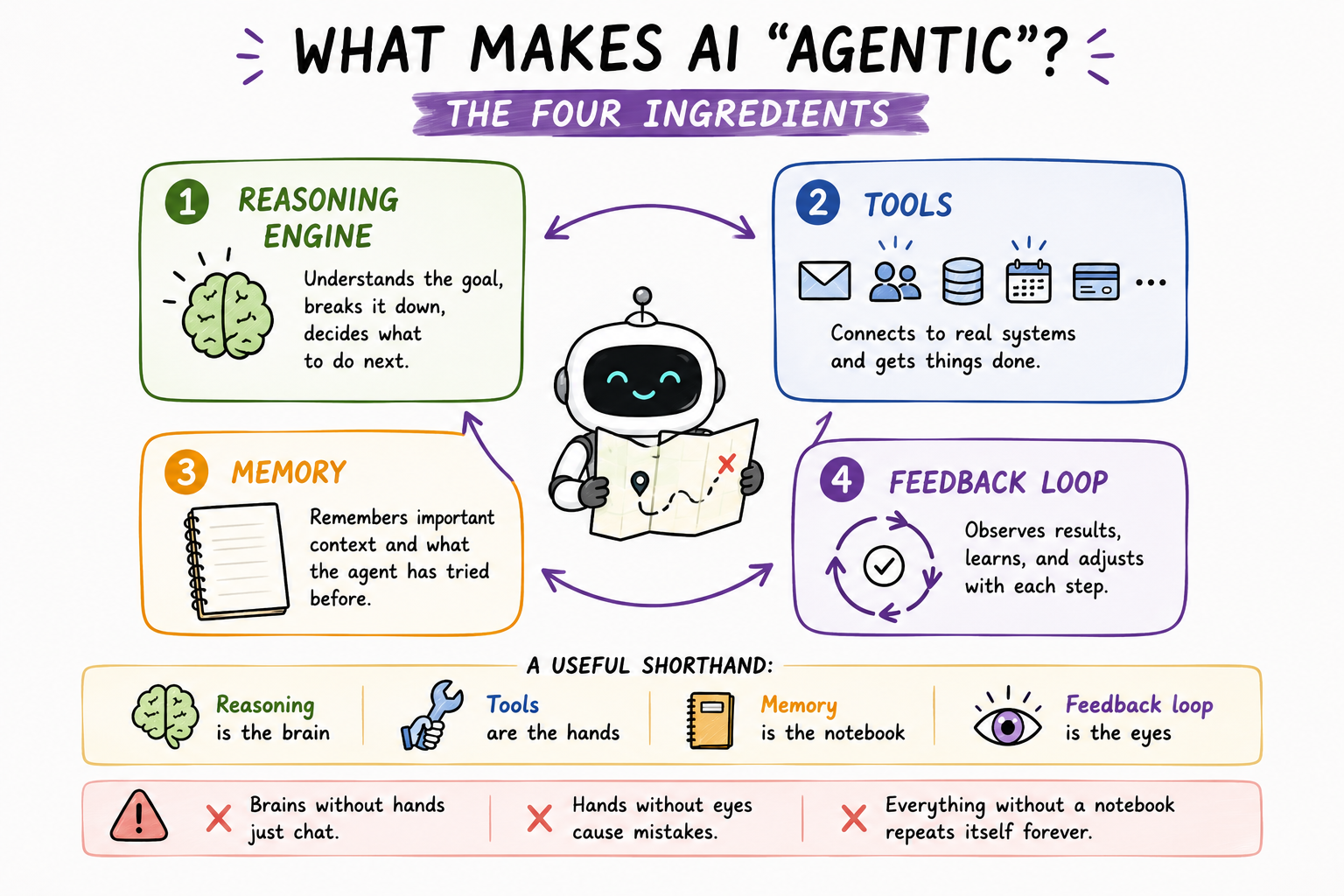
Four Ingredients of Agentic AI
What Agentic AI Is Not (The Disambiguation Section)
The term gets stretched daily, so here are the boundary lines.
Not a chatbot. A chatbot converses; the conversation is the product. An agentic system acts; the conversation, if any, is just the interface. The full comparison lives in [AI Agents vs Chatbots].
Not workflow automation. Zapier-style automation follows steps a human drew: when X, do Y, every time, brilliantly. Agentic AI decides its own steps. The pillar's ten-second test remains the sharpest tool in the drawer: does it decide its own steps, or follow steps a human drew on a canvas? Deciders are agentic. Followers are automation wearing this season's word. Both are valuable; they are priced, governed and deployed completely differently.
Not AGI. Agentic does not mean generally intelligent, conscious or autonomous in the science-fiction sense. Today's agentic systems are narrow professionals: superb within a well-defined job, lost outside it. The businesses succeeding with them treat them exactly like that: specialists with a job description, not digital employees with initiative.
Not one product. Agentic AI is an architecture pattern, not a thing you buy in a box. It arrives as features in platforms you own, as agent products, and as custom builds, which is why evaluating "role, not product" (the [Assistant-Analyst-Agent Framework]) beats comparing logos.
Why Did This Term Suddenly Take Over?
Because the capability genuinely changed, and the market noticed at once.
For decades, automation meant rules, and rules have a hard ceiling: they cannot read an angry email and decide how apologetic to be, cannot reconcile a messy invoice, cannot handle the case nobody anticipated. The work that stayed manual in every business stayed manual precisely because it needed judgment.
Large language models cracked that ceiling: software that reads, reasons and improvises. Wrapping that reasoning with tools, memory and feedback loops (the four ingredients) turned it from a conversationalist into a worker. The numbers tell the adoption story: Gartner expects 40% of enterprise applications to embed task-specific agents by the end of 2026, up from under 5% in 2025, and the agentic market grew from roughly $7.6 billion in 2025 to a projected $10.8 billion in 2026.
And the honest counterweight, which belongs in every definition: Gartner also expects 40% of agentic AI projects to be cancelled by end of 2027, mostly for unclear ROI and poor governance. Both numbers are true at once. The capability is real; the discipline required to deploy it is equally real, and the businesses treating "agentic" as a magic word rather than an architecture populate the second statistic.
What Does Agentic AI Look Like in a Real Business?
Concrete beats abstract, so three everyday shapes:
The returns handler. Goal: "process return requests under £200 against our policy; escalate everything else." The agent reads each request, pulls the order, checks the policy, issues the label or routes to a human, and logs everything. Narrow, bounded, valuable: the classic first agent.
The research assistant. Goal: "profile these fifteen suppliers and recommend three, with reasons." The agent plans its research, gathers from multiple sources, cross-checks, drafts the comparison and flags the gaps it could not fill. Hours of knowledge work compressed to minutes, with a human making the actual decision.
The CRM keeper. Goal: "keep customer records current from our emails and meetings." The agent extracts, updates, logs and never complains about data entry. Invisible, unglamorous, and routinely the highest-satisfaction agent a small business deploys.
Notice the shared pattern: a goal with boundaries, tools scoped to the job, exceptions escalating to humans. That pattern, not any specific use case, is what "deploying agentic AI well" means. The multi-agent versions, where several specialists cooperate on bigger goals, are the next chapter: [Multi-Agent Systems Explained].
The Spectrum of Agency: It Is a Dial, Not a Switch
One more idea completes the definition, and it is the one that makes deployment decisions rational: agency comes in degrees. Systems are not "agentic or not"; they sit on a dial, and you choose the setting per workflow.
Setting 1: Suggests. The AI drafts, recommends, prepares; a human executes everything. Full agentic machinery inside (reasoning, tools for reading, memory), zero authority. This is where every new deployment should start, because it delivers most of the learning at none of the risk.
Setting 2: Acts with approval. The AI does the work end to end but pauses at designed gates for a human click before anything consequential executes. Most well-run SMB agents live here permanently for money and commitments, and it is the setting our [Human Approval] article is devoted to.
Setting 3: Acts within bounds, reports after. Routine, reversible, well-measured categories flow at machine speed, with humans reviewing logs and exceptions rather than approving each action. Earned, category by category, by months of clean approval records.
Setting 4: Fully autonomous. No human in the loop at all. Honest guidance: almost nothing in a small business belongs here except the trivially reversible, and any vendor leading with this setting is optimising for the demo, not for you.
The dial reframes the entire adoption question. "Should we use agentic AI?" becomes "which workflows, at which setting, moving up on what evidence?", and that question has a manageable, reversible, measurable answer. Businesses get into trouble not by using agentic AI but by starting workflows at setting 3 that had earned only setting 1. The dial only turns one way safely: up, on evidence, per category, with the logs to justify each notch.
What Are the Limitations?
Plausible failure. Agentic systems fail politely: output that looks right but is not. This single property drives most of the discipline around them: quality monitoring, [reflection loops], and humans reviewing what matters.
Cost scales with thinking. Reasoning burns tokens, and complex multi-step tasks burn many. Agentic AI is the wrong tool for high-volume rule-shaped work, which belongs on cheap deterministic rails; the winning pattern is hybrid, covered in [The Hybrid Automation Stack].
Authority requires governance. An AI that acts needs what any actor needs: scoped permissions, approval gates on the consequential stuff, audit trails and an escalation path. None of it is optional, and all of it is cheapest on day one ([AI Agent Governance] is the full manual, and [Human Approval] the deep dive on the gates).
The word itself is polluted. The market's loosest usage of "agentic" is the buyer's biggest hazard. Keep the two tests handy: does it decide its own steps, and can the vendor show you yesterday's action log? Adjectives are not architecture.
Frequently Asked Questions
What does agentic AI mean in simple terms? AI that works toward a goal rather than answering a single prompt: it plans steps, uses tools, remembers context, checks results and adjusts, escalating to humans at the edges of its authority. Cruise control follows a setting; a chauffeur handles a destination. Agentic AI is the chauffeur.
What is the difference between agentic AI and generative AI? Generative AI produces content when asked: text, images, code. Agentic AI uses that generative capability as a reasoning engine inside a larger loop of planning, tool use and feedback to complete tasks. Every agentic system contains generative AI; most generative AI use is not agentic.
What is the difference between agentic AI and an AI agent? Agentic AI is the pattern; an AI agent is one system built on it. In practice the terms travel together: an agent is the worker, agentic describes how it works, and multi-agent systems are teams of them. [The anatomy article] dissects a single agent in detail.
Is ChatGPT agentic AI? As a chat window, no: it responds to prompts. Given tools, memory and goals (which modern AI platforms increasingly support), the same model becomes the reasoning engine of an agentic system. Agentic is a property of the architecture around the model, not of the model itself.
What are examples of agentic AI in small businesses? Returns processing within policy limits, invoice chasing matched to customer history, CRM records maintained from real emails, supplier research and comparison, support tickets resolved end to end with escalation paths. The common shape: one bounded goal, scoped tools, humans on the exceptions.
Should my business adopt agentic AI now or wait? Adopt the sequence, not the headline: prove value with assistants and simple automation first, then deploy one bounded agent on a measured workflow, then expand on the plumbing you have paid for. The pillar guide runs this decision with real ROI maths, and the [90-Day Roadmap] turns it into a calendar.
What is the difference between agentic AI and RPA (robotic process automation)? RPA scripts a computer to click and type like a human would: fixed steps, brittle when screens change, no judgment. Agentic AI reasons toward goals and adapts. They are not rivals in practice: RPA often serves as hands for legacy systems without APIs, while the agentic layer does the deciding. The distinction to hold onto is the pillar's test: RPA follows steps a human recorded; agents choose their own.
Who are the main platforms and frameworks for agentic AI? The model providers (Anthropic, OpenAI, Google) supply the reasoning engines; frameworks like LangGraph, CrewAI and the OpenAI Agents SDK structure agents and teams; automation platforms (n8n, Zapier, Make) now ship visual agent builders; and MCP standardises tool connections across all of them. Our [AI automation stack] guide tours every layer, and [n8n vs Zapier vs Make] compares the platform tier. The strategic point: the architecture pattern is stable even as the logos rotate, so learn the pattern.
The Takeaway
Agentic AI, minus the noise: software with agency. A reasoning brain, tool-using hands, a memory notebook and feedback-loop eyes, pursuing goals you set within boundaries you control. Not a chatbot, not a Zap, not science fiction: a new kind of worker that needs what every worker needs, a clear job, the right keys and a manager who reads the reports.
Keep the chauffeur in mind, keep the ten-second test handy, and treat the word on every pitch deck as a claim to verify rather than a feature to buy. The rest of this series opens the bonnet: [the agent's anatomy], [teams of agents], and the four ingredients one by one.
Bots and Brand Works builds agentic systems for businesses that want the chauffeur without the mystery: bounded goals, scoped tools, honest maths. If a pitch has left you unsure whether you are being offered agency or adjectives, forward it over and we will translate, free.
Need Help Implementing AI?
Read our FAQ section to learn more.
Resources and Further Reading
- Agentic AI vs Workflow Automation: The 2026 Enterprise Guide
- [What Is an AI Agent? The Anatomy]
- [The Assistant-Analyst-Agent Framework]
- Gartner on task-specific agents Click Here
- Agentic AI adoption statistics Click Here
- Anthropic: Building effective agents Click Here