

What Is an Agent Loop? The Cycle That Makes AI Autonomous
The agent loop : (assemble context, reason, act, observe, repeat) is the core architecture behind every autonomous AI system. How it works, where ReAct fits, what one cycle costs, and why loop quality decides agent quality.
Every autonomous AI system, from the coding agents in the headlines to the returns handler quietly working a small business's inbox, runs on the same heartbeat. Not a technology, exactly: a rhythm. Look at the situation, decide one thing to do, do it, see what happened, and go again.
That rhythm is the agent loop, and it deserves to be understood on its own terms, because it is the answer to the question every newcomer to agentic AI eventually asks: how does a system built on a model that only predicts text ([the improviser], from our LLM guide) manage to DO things, adapt, recover from failures and finish multi-step work? The answer is not a smarter model. It is the loop wrapped around the model, and the quality of that loop, more than almost anything else, decides whether an agent is reliable or merely impressive.
This article is the foundation stone of our [loop engineering] cluster: what one cycle of the loop actually contains, where the famous ReAct pattern fits, what a cycle costs, how loops nest inside bigger loops, and the questions that reveal loop quality from the outside.
What Is the Agent Loop, Precisely?
One cycle of an agent loop contains five moves, and every autonomous AI system you will ever evaluate runs some version of them:
1. Assemble context. Gather what the agent needs to think with: the goal, the conversation or case so far, retrieved knowledge from your documents, results of previous steps. This is [working memory] being stocked, and the quality of this step quietly caps everything after it.
2. Reason and choose. The model considers the assembled context and selects the next action: call this tool, ask this question, draft this reply, declare the task done. One decision, not a grand plan (the plan lives a level up; see [Agent Planning]).
3. Act. The chosen action executes through the [tool-calling] machinery: the model requests, the harness validates and performs, reality is touched.
4. Observe. The result comes back (the order details, the error message, the confirmation) and joins the context. This is the feedback that makes the loop a loop rather than a script: the next decision will be made knowing what just happened.
5. Check for done or stop. Is the goal met? Has a budget or boundary been hit? Should this escalate? If none of those: cycle again, with the loop's memory one observation richer.
The analogy that carries the article: a game of chess. No player decides all forty moves in advance; they assess the board, make one move, watch the reply, and assess again. The intelligence is not in any single move; it is in the rhythm of move-observe-reassess, sustained until checkmate or a draw offer. An agent loop is exactly that rhythm applied to work, and "how good is this agent?" mostly unpacks to "how good is each part of its rhythm?": what it sees before moving (context), how it chooses (reasoning), how honestly it reads the board after (observation), and whether it knows when the game is actually over (the done-check).
Where ReAct Fits: The Pattern Behind the Pattern
Most modern agent loops trace to a 2022 research idea called ReAct (Reason + Act), from researchers at Princeton and Google. The insight was almost embarrassingly simple: instead of asking a model to answer in one shot, interleave its reasoning with actions: think out loud, take one action, see the result, think again.
Why this mattered: it let the model's reasoning steer around reality rather than hallucinate past it. A one-shot answer to "is this customer's return eligible?" invites the [improviser's confident guess]; a ReAct loop looks up the order (act), reads the actual date (observe), reasons about the policy with the real date in hand, and answers from evidence. Each cycle grounds the next thought in an observed fact, which is the loop's whole gift: it converts a text-predictor into an evidence-user.
Every framework in our [comparison guide] implements this rhythm with different management styles, and the [plan-as-you-go versus plan-then-execute] distinction from the planning article is really a question about how much route-map sits above the ReAct heartbeat. The heartbeat itself is universal.
Loops Inside Loops: The Full Nesting
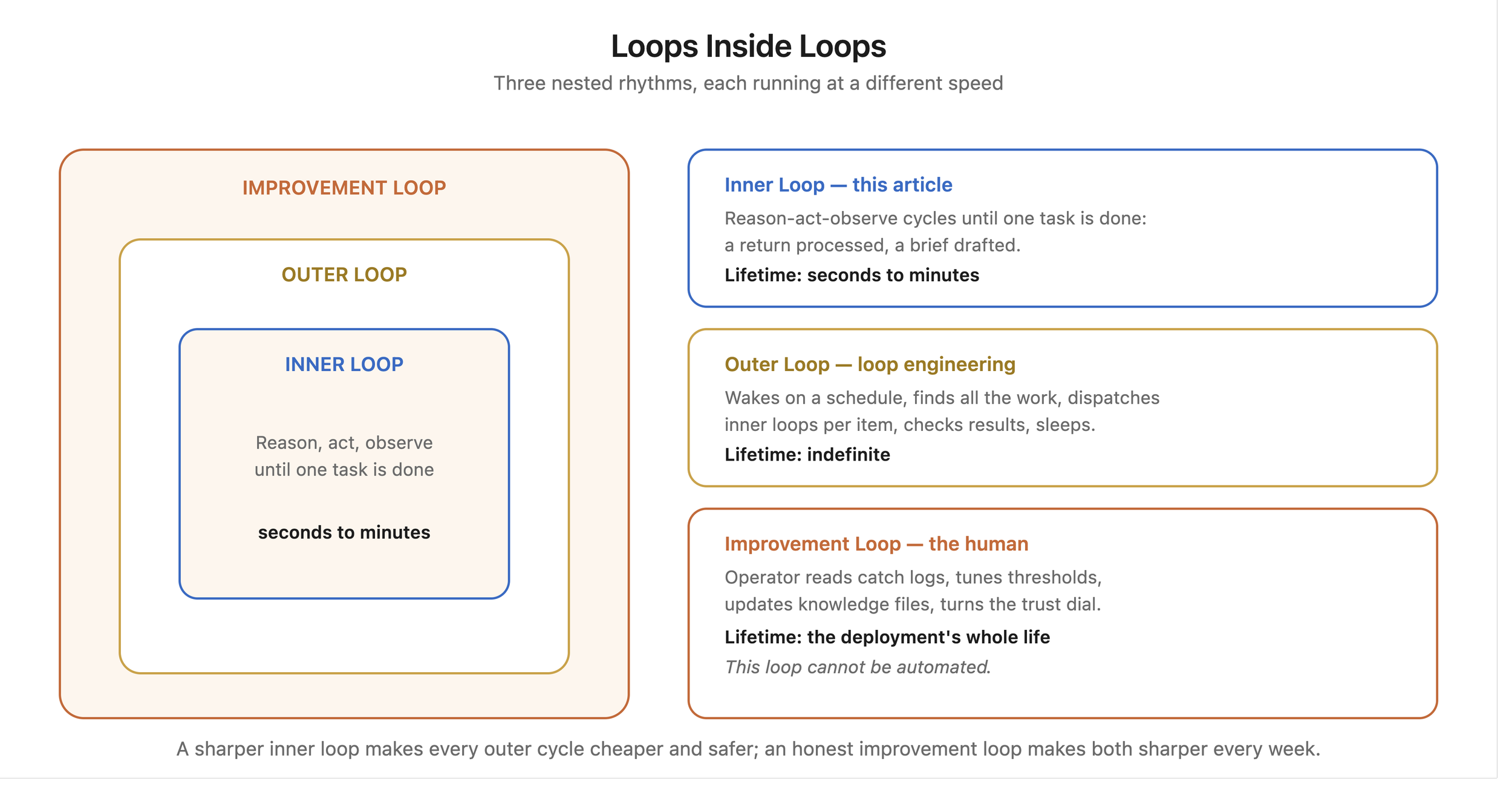
Here is the picture that connects this article to the whole cluster, worth a diagram in the published version:
The inner loop (this article): one task. Reason-act-observe cycles until the return is processed or the brief is drafted. Lifetime: seconds to minutes. This is what "agent" mostly meant until recently.
The outer loop ([loop engineering's] subject): the recurring goal. A heartbeat wakes the system on schedule; it finds all the work (every overdue invoice, every new ticket), dispatches inner loops per item, checks results, records state, and sleeps until tomorrow. Lifetime: indefinite. The human designed it once and now owns it rather than runs it.
The improvement loop (the human one): the operator reviews. Catch logs read, thresholds tuned, knowledge files updated, the [trust dial] turned on evidence. Lifetime: the deployment's whole life. This loop is the one that cannot be automated, and the [pillar's] closing warning (build the loop, stay the engineer) is precisely about keeping it alive.
The nesting explains why loop quality compounds: a sharper inner loop makes every outer cycle cheaper and safer, and an honest improvement loop makes both sharper every week.
What Does One Cycle Cost? The Economics of the Rhythm
Every cycle spends three things, and loop design is the management of all three.
Tokens. Each reason-step is a model call, priced per token ([the meter], from our LLM guide). Context assembled carelessly (the whole history re-sent every cycle, irrelevant documents attached) multiplies cost invisibly; context assembled well (summaries, retrieval on demand, codified knowledge read once) keeps cycles lean. Most runaway agent bills are context-assembly problems wearing a mystery costume.
Time. Cycles are seconds each; tasks are usually dozens of cycles. Fine for almost all business work, and the reason genuinely instant, high-frequency decisions belong on [deterministic rails] instead.
Trust. Every cycle that acts is a cycle that can act wrongly. This is why the observe step must be honest (errors surfaced, not swallowed), why [verification] earns its own article in this cluster, and why cycle-level logs (what was seen, chosen, done, observed) are the difference between a debuggable system and a mystery. Ask any vendor to show you one task's cycle log; it is the loop-era version of asking to see the books.
A Worked Cycle: Eight Turns of a Real Loop
A subscription business's payment-recovery agent, one task, real rhythm:
- Cycle 1: context assembled (failed payment, customer record, dunning policy); reasoning picks "check if the card was retried overnight"; tool call; observation: retry also failed.
- Cycle 2: reasoning picks "check customer's history"; observation: four years, never failed before.
- Cycle 3: policy retrieval; observation: long-standing customers get the gentle path.
- Cycle 4: draft the gentle email (maker).
- Cycle 5: [checker] reviews draft against policy and tone; observation: flag, the draft mentioned a late fee the gentle path waives.
- Cycle 6: redraft; checker passes.
- Cycle 7: send via approved-drafts tool; observation: sent, logged.
- Cycle 8: done-check: goal met for this item; write state ("gentle path day 1, review in 3 days"); stop.
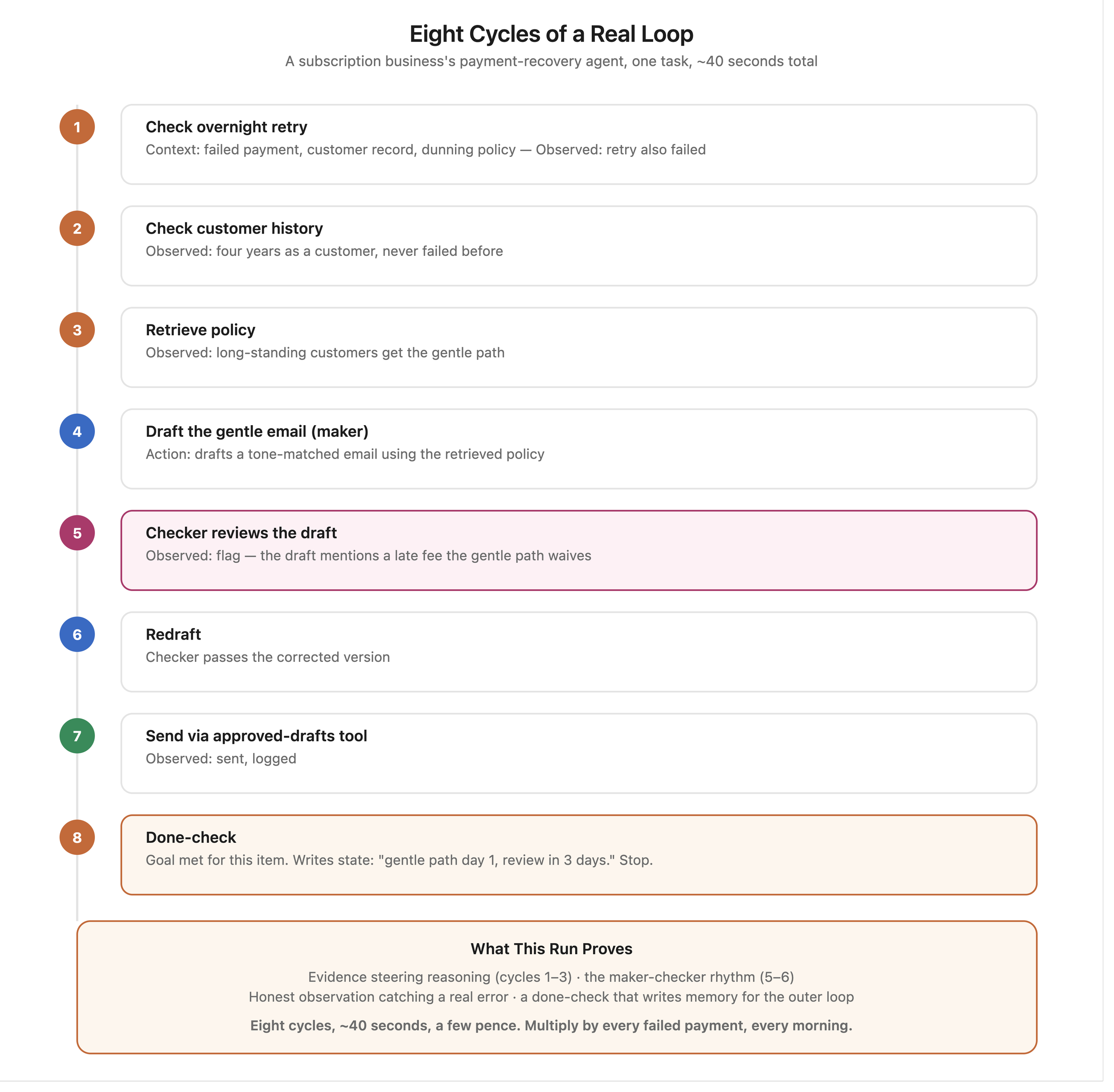
Eight cycles, perhaps forty seconds, a few pence. Notice everything this article claimed, visible in miniature: evidence steering reasoning (cycles 1 to 3), the maker-checker rhythm (5 and 6), honest observation catching a real error, and a done-check that wrote memory for the [outer loop's] next visit. Multiply by every failed payment, every morning, forever: that is the heartbeat becoming a system.
What Are the Limitations of the Loop?
Loops inherit their model's blind spots. The reasoning step is still [the improviser]: a loop grounds and checks it but cannot transplant judgment it does not have. Hard tasks still need the stronger (dearer) models at the reasoning moments; [model routing] is loop design too.
Observation is only as honest as the tooling. A tool that returns "success" when it half-worked poisons every subsequent cycle. The harness's honesty (real errors, real statuses) is inherited by the whole rhythm, which is why boring integration quality keeps deciding glamorous outcomes.
Loops can circle. Without step budgets and loop detection, a confused agent re-tries its way around the same three cycles at machine speed. The fixes live in [Stopping Conditions], this cluster's next article, and they are not optional equipment.
More cycles is not more intelligence. A hundred wandering cycles lose to eight well-contexted ones. When an agent seems dim, the instinct is to blame the model; the audit usually finds the context-assembly step starving it. Feed the loop before upgrading the brain.
Where You Have Already Met the Loop
The agent loop is not a laboratory concept; it has quietly shipped into products you may already use, and recognising it there sharpens the eye.
Run-until-done features. The coding world's /goal commands (in both Claude Code and OpenAI's Codex) are the loop made visible: give a verifiable condition ("all tests pass"), and the system cycles until an independent check confirms it holds. Watch one run and you are watching this article's five moves on fast-forward, including the [maker-checker done-check] this cluster keeps returning to.
Deep-research modes. When an AI assistant's research feature works for ten minutes and returns a sourced report, that was a loop: queries issued, results observed, gaps reasoned about, further queries chosen, until a coverage condition was met. The pauses you watched were cycles.
Agent platforms' execution views. n8n's agent nodes, and their peers, expose the rhythm directly in their run logs: reason, tool call, observation, repeat. If your business runs any [platform-built agent], the cycle log this article told you to demand is probably one click away already, unread.
Your own best delegations. The loop is also why good delegation to humans works: brief, act, report back, adjust. Businesses that already run tight check-in rhythms with staff find loop thinking familiar rather than foreign, one more way [readiness] is mostly management hygiene wearing a technology costume.
The practical point: before commissioning anything, watch a loop you already have access to, cycle log open. Ten minutes of observed rhythm teaches the five moves better than any diagram, this article's included.
The Buyer's Loop Questions
- "Show me one task's cycle log." Context, choice, action, observation, per cycle. Its existence is the qualification; its readability is the quality.
- "What does the done-check actually verify?" "The model says finished" is a claim; a checked condition ("payment recovered or escalated, state written") is an answer.
- "What are the per-task budgets?" Cycles, tokens, time. Unbudgeted loops are taps.
- "How is context assembled each cycle?" Retrieval and summaries mean discipline; "we send the full history" means invoices.
- "What happens on a tool error mid-loop?" Retry-with-limits then escalate is the grown-up answer; "it usually works" is not.
Frequently Asked Questions
What is an agent loop in AI? The repeating cycle that makes AI autonomous: assemble context, reason and choose one action, execute it, observe the result, check whether the goal is met or a boundary hit, and repeat. Every agentic system runs this rhythm; quality differences between agents are mostly quality differences between their loops.
What is the ReAct pattern? Reason + Act: the 2022 research insight that interleaving a model's reasoning with real actions (think, act, observe, think again) grounds each thought in evidence rather than letting the model hallucinate past reality. It is the ancestor of most modern agent loops and the default rhythm of single agents.
How many cycles does an agent task take? Typically a handful to a few dozen: our worked example runs eight cycles in about forty seconds. Cycle counts balloon when context is poorly assembled or stopping conditions are missing, which is a design smell rather than a task property; budgets per task keep the rhythm honest.
What is the difference between an agent loop and loop engineering? The agent loop is the inner rhythm: one task, cycled to completion. Loop engineering designs the outer system: a scheduled, goal-driven loop that finds work, dispatches inner loops, verifies, remembers and continues indefinitely. Inner loops existed all along; the outer discipline is what got named in 2026.
Why do agents get stuck repeating the same steps? Circling: the loop lacks loop-detection, step budgets or a route-level plan, so locally sensible cycles repeat at machine speed. Standard fixes: budgets, detection, an upfront plan and replan triggers, covered across [Agent Planning] and [Stopping Conditions].
Does a better AI model mean a better loop? It helps the reasoning step and nothing else. Context assembly, observation honesty, done-checks, budgets and logs are engineering, not model quality, and they are where most real-world agent differences live. Feed and check the loop before paying for a bigger brain.
The Takeaway
The agent loop is the heartbeat under everything this Knowledge Hub describes: see the board, make one move, read the reply, move again, know when the game is over. Not magic; a rhythm, engineerable at every step: what the agent sees, how it chooses, how honestly it observes, when it stops.
Learn to ask for the cycle log and the done-check, and you can evaluate any autonomous system from the outside in ten minutes. And once the heartbeat makes sense, the bigger idea follows naturally: put it on a schedule, give it memory and boundaries, and you have arrived at [loop engineering], where the rest of this cluster lives.
Bots and Brand Works builds loops with readable heartbeats: cycle logs, checked done-conditions, budgets on every task. If an agent in your business ever "just ran long," send us the story and we will tell you which cycle step leaked, free.
Need Help Implementing AI?
Read our FAQ section to learn more.
Resources and Further Reading
- Loop Engineering: The Complete Business Guide
- Related: What Is an AI Agent? The Anatomy
- Related: Agent Planning Explained
- ReAct paper (Yao et al.): link text
- Oracle: What Is the AI Agent Loop: link text
- Anthropic: Building effective agents: link text