

Vector Databases and RAG Explained: How AI Learns Your Business (Without Training)
RAG and vector databases are how AI answers accurately from your company's own documents, no training required. A plain-English guide for business owners, with real examples and an implementation path.
Two worries stop more small businesses from using AI than everything else combined.
The first: "AI makes things up. I can't have it inventing prices to my customers." Entirely fair. It does, and you can't.
The second: "To make AI know my business, I'd have to train it on my data, and that sounds expensive, technical and a bit risky." Also fair, except for one thing: it is almost completely wrong.
The technique that solves both problems at once is called RAG, short for Retrieval-Augmented Generation, and it works with something called a vector database. Two of the least friendly names in all of tech, describing one of the most business-friendly ideas: instead of teaching the AI your business, you hand it the right page of your handbook at the right moment.
This article explains both, in plain English, and by the end you will know exactly what people mean when they say "we'll ground the chatbot in your documents," and why that sentence should be in every AI proposal you accept.
What Is RAG (Retrieval-Augmented Generation)?
Strip the jargon and RAG is three words doing exactly what they say:
Retrieval: find the relevant bits of your company's information. Augmented: add those bits to the AI's instructions. Generation: let the AI write its answer using them.
The analogy: picture an open-book exam. A student answering from memory alone will misremember dates, mix up formulas and confidently write nonsense, exactly what an AI does when it "hallucinates." Give the same student the textbook, open at the right page, and the answers suddenly cite the actual material. Same student, same intelligence, completely different reliability.
RAG is the open book. The AI model (the brilliant student) stays exactly as it is. What changes is that before it answers any question, the system finds the relevant pages from your documents, your prices, your policies, your product specs, and slides them across the desk. The AI answers from what is in front of it, not from what it half-remembers about businesses in general.
One sentence worth keeping: RAG does not make the AI smarter, it makes the AI informed.
What Is a Vector Database?
RAG's whole trick depends on one hard problem: finding the right pages fast. That job belongs to the vector database.
The analogy: a normal database search is the index at the back of a book. Look up "refund" and it finds pages containing the exact word "refund." Useful, but literal-minded. If your customer asks "can I get my money back?", an exact-word search for "money back" finds nothing, even though your refund policy answers the question perfectly.
A vector database is a well-read librarian instead. Ask her about "getting my money back" and she hands you the refund policy, the returns process, and the goodwill-gesture guidelines, because she understands those are the same idea wearing different words.
How the librarian trick works, in one paragraph: every chunk of your documents gets converted into a list of numbers (called an embedding) that captures its meaning, a bit like giving every paragraph a coordinate on a giant map of ideas. Paragraphs that mean similar things sit close together on the map, whatever words they use. When a question arrives, it gets a coordinate too, and the database simply grabs the nearest neighbours. "Money back" and "refund" land on almost the same spot, so the right policy is found even though the words never matched.
Popular tools in this space include Pinecone, Weaviate, Qdrant and pgvector. That last one matters for small businesses: pgvector adds the librarian's skills to PostgreSQL, the trusty filing-cabinet database that most systems already use, so smaller setups often get both memories in one place without buying another product. (Both memory types have a home in our [AI automation stack] guide.)
Why Should a Business Care?
Because this is the cure for making things up. Ungrounded AI answers about your business from statistical guesswork about businesses like yours. Grounded AI answers from your actual documents. It is the single biggest reliability upgrade available, and it is why "is it grounded in our documents?" should be your first question about any AI that talks to customers.
Because you almost certainly do not need training. "Training an AI on your data" means changing the model itself, which is expensive, slow, and mostly unnecessary for SMBs. RAG achieves what most businesses actually want (AI that knows current prices, policies and processes) by retrieval instead. And when your prices change, you update a document, not a model. Training bakes the cake; RAG keeps the recipe folder up to date.
Because your documents become an asset. Years of policies, FAQs, proposals and how-to notes stop being a folder nobody reads and become the knowledge behind every AI answer. Businesses that write things down get compounding returns from this; it quietly rewards the organised.
Because sources become checkable. Good RAG systems cite which document each answer came from. When an answer looks off, you can see exactly which page misled it, fix that page, and the fix applies everywhere, instantly. Try doing that with a trained model.
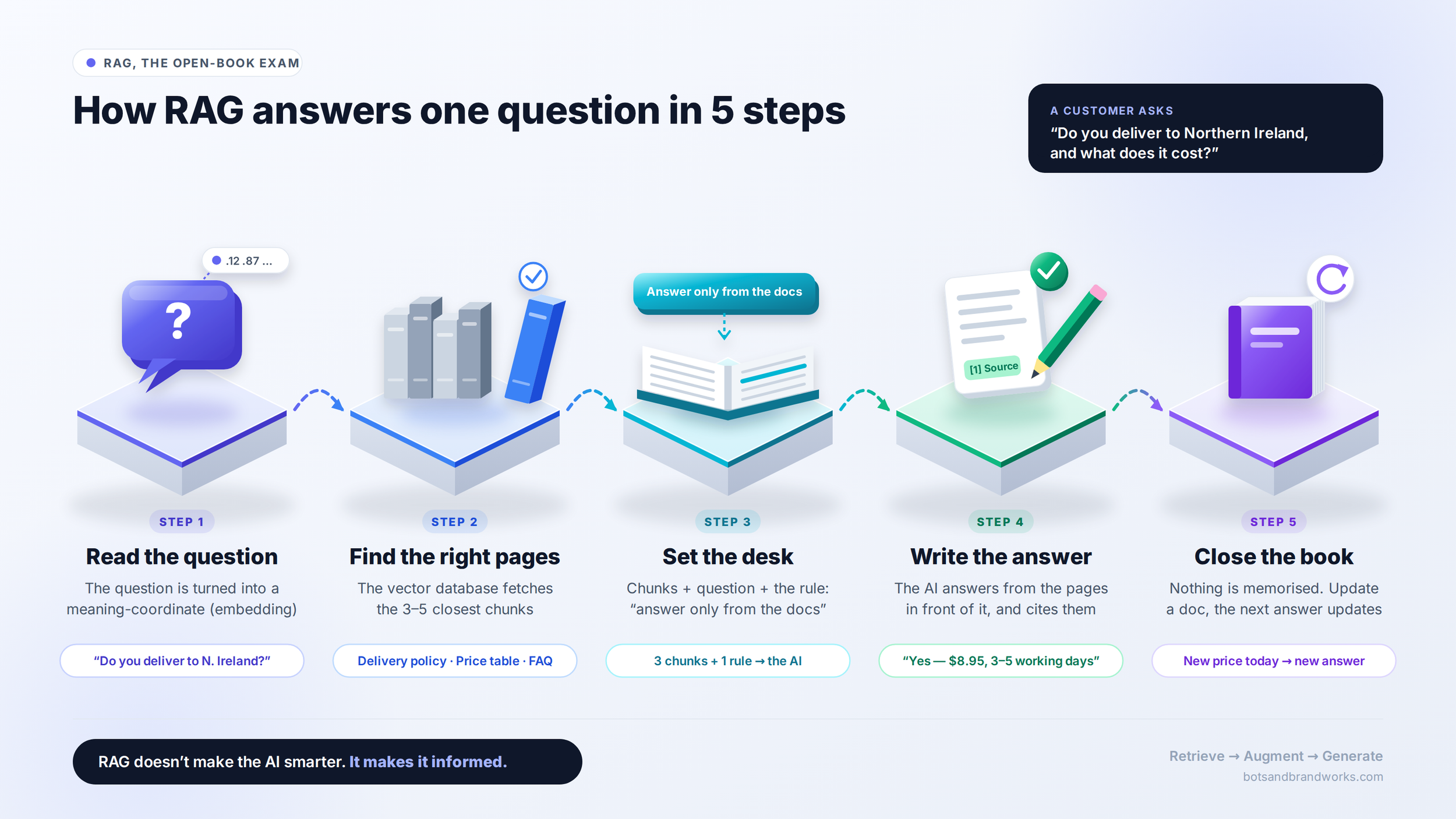
How Does RAG Work? The Journey of One Question
Let's follow a real question through the system. A customer types: "Do you deliver to Northern Ireland, and what does it cost?"
Step 1: The question becomes a coordinate. The system converts the question into its meaning-fingerprint, the same kind your documents already have.
Step 2: The librarian fetches. The vector database finds the nearest chunks on the meaning-map: a paragraph from your delivery policy, the shipping price table, and a line from your FAQ about UK-wide coverage. Typically the top three to five chunks, not the whole filing cabinet.
Step 3: The desk is set. Those chunks are placed in front of the AI along with the question and standing instructions, which usually include the most important sentence in the whole system: "Answer only from the provided documents. If they don't contain the answer, say so."
Step 4: The answer is written. "Yes, we deliver to Northern Ireland. Standard delivery is $8.95 and takes 3 to 5 working days," with the delivery policy cited as the source.
Step 5: Nothing was memorised. The next question starts fresh. The AI never absorbed your documents; it consulted them. Update the price table tomorrow and tomorrow's answers use tomorrow's prices.
Behind the scenes there is a housekeeping process keeping the library current: when documents change, their chunks and coordinates get refreshed. That is the part your provider maintains, and it is worth asking how often it runs.
What Are the Benefits?
Dramatically fewer made-up answers. Grounding plus the "say so if you don't know" instruction turns the failure mode from confident nonsense into an honest "I don't have that information, let me connect you with the team." The second one never ends up as a screenshot on social media.
Always current. The AI's knowledge is exactly as fresh as your documents. Price change at 9am, correct answers by 9:05, no retraining, no rebuild.
Your data stays yours. Documents sit in your storage and are retrieved at question time. Nothing about RAG requires handing your knowledge over to train someone's model, and reputable AI providers offer business terms that do not train on your data either. (Ask anyway. It is a one-sentence answer.)
Affordable. A grounded assistant sits at the lower end of custom builds, typically $3,000 to £$,000 with modest monthly running costs, as covered in our pricing guide For comparison, meaningful model training starts at multiples of that and never stops needing updates.
What Are the Limitations?
The honesty section, as always.
The library is the ceiling. RAG answers from your documents, so if the documents are wrong, outdated or missing, the answers will be too, now delivered fluently and at scale. Garbage in, eloquent garbage out. The preparation step that actually matters is fixing the handbook, not tuning the tech.
Retrieval can fetch the wrong page. The librarian is very good, not perfect. Ambiguous questions, near-duplicate documents ("Returns Policy v3" and "Returns Policy FINAL v2") or badly chunked files can put the wrong page on the desk, and the AI will faithfully answer from it. This is why professional builds include retrieval testing and why monitoring (see our AI automation stack guide) is non-negotiable.
Reduced is not eliminated. RAG cuts hallucination dramatically but no honest provider says "to zero." For anything high-stakes, keep source citations on and humans in the loop.
It answers, it does not act. RAG makes AI informed, not capable. Booking the delivery slot rather than describing the delivery policy needs an agent with tools, which is a different (and pricier) project, as explained in AI Agents vs Chatbots and in our pillar guide, Agentic AI vs Workflow Automation.
How Does RAG Compare to the Alternatives?
RAG vs fine-tuning (actual training). Fine-tuning changes the model itself, and it is the right tool for teaching style and behaviour: a specific tone of voice, a strict output format, a specialised classification skill. It is the wrong tool for teaching facts that change, because every price update would need a retraining round. Rule of thumb: facts and knowledge → RAG; style and behaviour → fine-tuning; most SMBs → RAG only, with tone handled by good instructions.
RAG vs a long prompt (just paste the handbook in). For a tiny, stable knowledge base, pasting key facts into the AI's standing instructions genuinely works, and modern models can hold a lot. But you pay for every pasted word on every single question, answers get worse when buried in irrelevant text, and nobody wants to maintain a 200-page prompt. RAG fetches only what each question needs. Under roughly 20 pages of stable content, the paste approach is a fine start; beyond that, retrieval wins on cost and accuracy.
RAG vs search (why not just use the search bar?). Search finds documents and leaves the reading to you. RAG finds the passages, reads them, and answers the question, citing where it looked. One hands you the folder; the other hands you the sentence you needed.
Real-World Examples
The letting agency's phone-call killer. A 40-property letting agency ingested its tenancy agreements, maintenance procedures and area guides into a vector database. Tenants now ask the portal assistant things like "who fixes a broken boiler and how fast?" and get the actual clause from their actual agreement, cited. Calls to the office dropped by a third, and the two staff answered the same question for the last time in 2025.
The manufacturer's instant quoter (of information, not prices). A components manufacturer with 800 product datasheets grounded an assistant for its sales team. "Which of our brackets are rated for outdoor marine use under 2kg?" now takes four seconds instead of a rummage through PDFs. Crucially, the system says "no rated product found" rather than guessing, which the sales director calls the most valuable sentence it produces.
The accountancy firm's onboarding shortcut. A firm loaded its internal procedures and tax-season checklists into a RAG system for new starters. Instead of interrupting a senior colleague, juniors ask the assistant, which answers from the firm's own manual and links the full document. The senior team measures the benefit in uninterrupted afternoons; the juniors, in not having to ask the same awkward question twice.
How Do I Implement RAG in My Business?
Step 1: Audit the handbook (week 1). Gather the documents that answer your most-asked questions: policies, prices, FAQs, procedures. Mark what is current, what is outdated, and what exists only in someone's head. This list decides your project more than any technology choice.
Step 2: Fix before you feed (weeks 1-3). Update the outdated, write down the tribal knowledge, delete the near-duplicates (the librarian hates "FINAL v2"). Every hour here saves arguing with wrong answers later.
Step 3: Start with one audience (weeks 3-6). Internal staff first is the low-risk classic: a grounded assistant for your team's own questions. The build is identical to the customer-facing version, but the mistakes land on colleagues, not customers.
Step 4: Demand grounding hygiene in the build. Three non-negotiables for whoever builds it: source citations on every answer, the "say I don't know" instruction, and monitoring so you can review what was asked and what was retrieved. All three are cheap at build time and expensive to retrofit.
Step 5: Review, then face outward (week 6+). Read the transcripts weekly. When the internal version is reliably right (and reliably honest about its gaps), promote it to customers, and only then consider whether it should also do things, which is the [agent conversation].
Frequently Asked Questions
-
Retrieval-Augmented Generation: retrieve the relevant passages from your documents, augment the AI's instructions with them, generate the answer from that material. In practice: an open-book exam instead of a memory test.
-
Almost certainly not. Training (fine-tuning) changes the model and suits style and behaviour, not facts. For "AI that knows our prices, policies and processes," RAG does the job at a fraction of the cost and updates the moment your documents do.
-
No, and distrust anyone who says otherwise. It reduces them dramatically, especially combined with source citations and the instruction to admit gaps. For high-stakes answers, keep a human review step.
-
Not as part of RAG; your documents are retrieved at question time, not absorbed. Separately, check your AI provider's terms: reputable business tiers do not train on your data, and it is a fair one-line question for any vendor.
-
A search system that finds information by meaning rather than exact words, like a librarian who knows "money back" and "refund" are the same request. It is the part of RAG that finds the right page fast.
-
Grounded off-the-shelf chatbot products start around tens of pounds a month. A custom-built grounded assistant typically runs $3,000 to $8,000 to build plus modest monthly costs. Full ranges and the ROI maths are in our [pricing guide].
-
Plain ChatGPT answers from its general training, which knows nothing current or specific about your business. RAG puts your documents in front of the same intelligence, so answers come from your actual policies and prices, with sources.
The Takeaway
RAG and vector databases have intimidating names and a homely job: making sure the AI reads your handbook before it opens its mouth.
That is the whole idea. Not a smarter AI, an informed one. Your documents become its knowledge, your updates become its updates, and "I don't know, let me check with the team" replaces confident invention.
If you remember one line for your next vendor conversation, make it this: "Will it be grounded in our documents, with sources cited, and will it say when it doesn't know?" Any builder worth hiring will smile at that question. You will have asked for RAG, done properly, without needing a single one of the scary words.
Bots and Brand Works builds grounded AI assistants for small and medium businesses: your documents, your tone, sources cited, honest about gaps. If your team answers the same twenty questions every week, send us the handbook and we will show you what it could sound like as an assistant.
Need Help Implementing AI Solutions?
Resources and Further Reading
Agentic AI vs Workflow Automation: The 2026 Enterprise Guide
Related: The AI Automation Stack Explained
Related: How Much Does AI Automation Cost?
Original RAG research paper (Lewis et al., 2020): Click Here
pgvector (vector search for PostgreSQL): Click Here
Pinecone learning centre: Click Here · Weaviate: Click Here · Qdrant: Click Here
Anthropic: Retrieval-augmented generation guidance: Click Here