

AI Agent Governance: Guardrails, Approval Gates and Audit Trails Explained
AI agents take real actions, so they need real rules. A plain-English guide to agent governance: least-privilege access, approval gates, audit trails, quality monitoring and the questions to ask any vendor.
Imagine hiring a brilliant new employee, giving them the master key to the building, the company credit card, and the ability to email every customer, and then going on holiday without leaving instructions.
Nobody would do that with a human. Businesses do it with AI agents every week.
Governance is the unglamorous word for not doing that: the rules, permissions, checkpoints and records that let an AI agent act on your behalf without keeping you awake at night. It is also rapidly becoming non-optional. Gartner attributes a large share of the 40% of agentic AI projects it expects to be cancelled by 2027 to poor governance, and our pillar guide predicts governance questions becoming standard procurement checks, the way security reviews became standard for SaaS.
The good news: agent governance is not a compliance department's worth of work. For most businesses it is five mechanisms, each explainable with an office analogy, each cheap at build time and expensive to retrofit. Here they all are.
What Is AI Agent Governance?
Governance is the set of controls that answer four questions about any AI agent, at any moment:
- What is it allowed to do? (permissions)
- What must it ask a human about first? (approval gates)
- What did it actually do, and why? (audit trail)
- Is it still doing its job well? (quality monitoring)
Note what governance is not: it is not about making the AI "ethical" in the abstract, and it is not paperwork for its own sake. It is the operational scaffolding that separates an agent you can trust with real work from a very clever liability.
The reason agents need this and chatbots mostly do not comes down to one word: actions. A chatbot's worst day is a wrong answer. An agent's worst day is a wrong action: a refund that should not have gone out, a contract clause accepted, an email blast to the wrong list. Power and safety requirements arrive together (our AI Agents vs Chatbots guide draws this line in full).
Why Should a Business Care Right Now?
Because incidents are expensive in a specific, avoidable way. The typical governance failure is not a movie-style rogue AI. It is a mundane oversight: an agent with database write-access it never needed, quietly corrupting records; a refund flow with no upper limit; nobody able to reconstruct what happened afterwards. Each of these is a five-minute design decision that was never made.
Because your first incident becomes your compliance review. Projects that launch without governance tend to meet it later, in the worst format: an incident, then an internal review the project was never designed to pass, then cancellation. This is failure pattern three in [Why 40% of AI Agent Projects Fail], and it kills working systems, not just bad ones.
Because buyers and regulators are starting to ask. If you sell to larger companies, expect "what can your AI do and who approved it?" on procurement questionnaires. Teams with written answers sail through; teams without stall in legal review. Governance is quietly becoming a sales asset.
Get the AI Agent Governance One-Pager. It's a free 2-page template you can fill in: owner, job description, access map, approval gates, logs and a quarterly review.
The Five Mechanisms, Explained With an Office
1. Least-Privilege Access: Not Every Key Opens Every Door
The idea: an agent gets the minimum access its job requires, and nothing more. The cleaner's key opens the office, not the safe.
In practice: an agent that drafts customer replies needs to read the helpdesk and read order status. It does not need write-access to the database, the ability to issue refunds, or the company card. Each connection to each system should be scoped: read-only where possible, specific accounts, specific data. Modern connection standards make this practical; MCP, the protocol most agent-tool connections now use, includes authorisation as part of its design (our MCP guide explains it without the jargon).
The ten-minute version: for every system the agent touches, write one line: "may read X, may write Y, may never touch Z." That document is worth more than most consulting engagements. Section 3 of our [free governance one-pager] gives you the table for this."
2. Approval Gates: The Counter-Signature
The idea: certain actions require a human yes before they happen, the way a big invoice needs a second signature.
In practice: the classic gated actions are money (refunds, payments, pricing), commitments (contracts, bookings over a threshold), and reach (anything sent to many customers at once). The agent prepares the action, a human approves with one click, the action executes. Done well, this costs seconds and catches the exact failures that make headlines.
The design trick: gates should be threshold-based, not blanket. "All refunds need approval" drowns the approver and teaches them to rubber-stamp. "Refunds over $200, or to accounts flagged in the last 90 days" keeps human attention for the cases that deserve it. Klarna's famous walk-back, rehiring humans after cutting too far, is the cautionary tale here: the durable pattern is agents for volume, humans for judgment, with the hand-off designed rather than improvised. Read more about Human Approval in AI Agents.
3. Audit Trails: The Signing-In Book
The idea: every action the agent takes is logged: what, when, on whose request, using what information, with what result. Like a visitor book, boring until the day it is the most important document in the building.
In practice: when a customer says "your AI told me the wrong price" or an order goes sideways, the audit trail turns an unsolvable mystery into a five-minute lookup. You see the conversation, the documents the agent retrieved, the decision it made, and the action it took. Fix the cause, not the symptom. Without the trail, every incident is guesswork, and guesswork erodes trust faster than the incident itself.
The buyer's test: ask any vendor to show you, live, the log of what their agent did yesterday. The quality of the answer tells you almost everything.
4. Quality Monitoring: Cameras, Not Just Smoke Alarms
The idea: deterministic software fails loudly, so uptime monitoring suffices. Agents can fail politely and plausibly, producing output that looks right but is not, so you must watch quality, not just uptime.
In practice: weekly transcript reviews in the first quarter, a simple quality score (answers correct? actions appropriate? escalations sensible?), and cost-per-task tracking, because per-use pricing means a misbehaving loop can burn real money overnight. Tools exist for this (LangSmith, Langfuse and similar), but the tool matters less than the habit: someone, weekly, reads what the agent actually did.
5. Boundaries and Escalation: Knowing When to Ask
The idea: a well-governed agent knows the edges of its job and has somewhere to send what falls outside them: the new hire who knows when to knock on the manager's door.
In practice: written scope ("handle return requests under $200 against this policy"), explicit refusals ("never discuss legal matters, never promise delivery dates"), and a designed escalation path (route to a named queue with full context attached, not a dead end). Escalation is not the agent failing; it is the agent working. The agents that get cancelled are usually the ones that guessed instead of asking.
How Does Governance Compare Across Setups?
Off-the-shelf tools (chatbot products, platform agents): governance is mostly inherited from the vendor: you get their guardrails, their logs, their limits. Fine for low-stakes uses; check what audit visibility you actually get.
Platform-built agents (n8n, Zapier Agents, Make): you assemble governance from platform features: connection scoping, approval steps as workflow nodes, execution logs. Workable for internal and moderate-stakes agents; the ceiling is whatever the platform exposes.
Custom agents: full governance is yours to design, which is both the burden and the point. Regulated industries and revenue-critical processes usually end up here precisely because they need audit trails shaped for their regulator, custom access controls per action, and formally testable guardrails. This is one of the five "move beyond platforms" signals in the pillar guide.
The rule of thumb: your governance should match your blast radius. Internal document assistant, light touch. Anything touching money, customers at scale, or regulated data, all five mechanisms, in writing.
What Are the Limitations? (Yes, Governance Has Them)
Governance cannot make a bad scope good. Guardrails around a fuzzy goal produce a well-guarded fuzzy outcome. Scope first, govern second.
Over-governance is a real failure mode. Gate everything and you have built an expensive suggestion box: humans re-doing every decision, savings evaporating, approvers rubber-stamping from fatigue. Thresholds exist to spend human attention where it earns its keep.
Rules go stale. Your policies change, your prices change, your risk appetite changes. Governance needs an owner and a review cadence (quarterly is plenty for most SMBs), or the guardrails slowly drift away from the road.
It is scaffolding, not a guarantee. Well-governed agents still occasionally err; the difference is that the error is small (least privilege), caught (monitoring), reversible (gates), and explainable (audit trail). That is the honest promise: not zero incidents, but no catastrophes and no mysteries.
Real-World Examples
The retailer's refund agent. Returns agent with authority up to $200 against written policy; above that, or any flagged account, one-click human approval with context attached. Read-access to orders, write-access only to the returns system, no database access. Every action logged. In its first year the audit trail settled four customer disputes in minutes each, twice in the customer's favour, which, the owner notes, built more trust than the automation itself.
The clinic that scoped reads only. A healthcare admin assistant that drafts appointment communications but sends nothing: every message goes to a staff outbox for one-click review. Patient data access is read-only and logged per lookup. Governance here was not overhead; it was the condition under which the project was allowed to exist at all.
The agency that learned about thresholds. First version gated every client email the agent drafted. Approvers rubber-stamped within a fortnight, defeating the point. Second version: auto-send for routine updates, gates only for anything mentioning money, deadlines or complaints. Human attention went from 40 approvals a day to 6 that mattered.
How Do I Implement Agent Governance? A One-Page Starter
- Write the job description. One page: what the agent does, what it never does, what it escalates. If you cannot write it, the project is not ready (see [Why 40% of AI Agent Projects Fail]).
- Scope every connection. Per system: read or write, which accounts, which data. Grant the minimum. Ten minutes per system.
- Pick your gated actions. Money, commitments, mass reach. Set thresholds, name the approver, put the approval one click away.
- Demand the trail. Every action logged and reviewable, from day one, whoever builds it. Ask to see the log in the demo.
- Diarise the watching. Weekly transcript reviews for the first quarter, then monthly. Quarterly governance review: permissions still right? thresholds still right? rules still current?
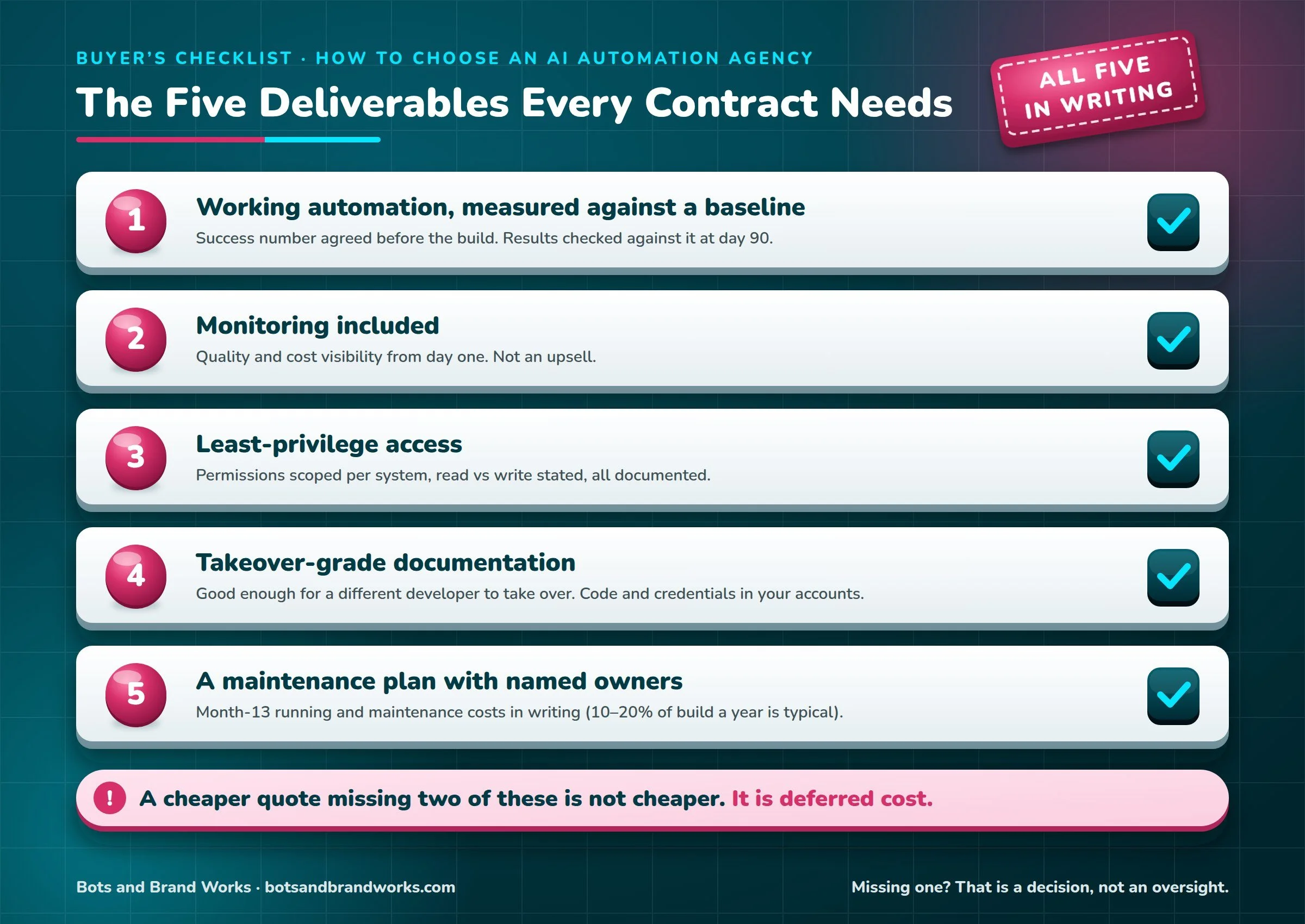
- Write the vendor questions into the contract.(Read about how to choose an agency) What can the agent access? What is gated? Where is the log? Who maintains the guardrails, and what does month thirteen look like?
That single page, honestly maintained, puts you ahead of a remarkable share of enterprise deployments.
Frequently Asked Questions
-
The rules and records around an AI that acts: what it may access (least privilege), what needs human sign-off (approval gates), what it did and why (audit trail), whether it is still performing (quality monitoring), and where its job ends (boundaries and escalation). Office-key logic applied to software.
-
A design where humans approve or review certain agent actions before or after they happen. You need it wherever an error is expensive or hard to reverse: money, contracts, mass customer contact, regulated data. Use thresholds so human attention goes to the cases that deserve it, not everything.
-
Scale the governance to the blast radius, but never to zero for an agent that acts. A five-person firm's refund agent still needs a spending limit, scoped access and a log. The one-page version above takes an afternoon and prevents the incidents that turn owners off automation permanently.
-
A layered mix: permission scopes on each tool connection, hard limits coded around actions (amounts, recipients, rates), instructions constraining behaviour, and checks on outputs before they execute. Standards like MCP carry authorisation as part of the connection, which makes scoping practical rather than aspirational.
-
A named person, not a committee: usually whoever owns the process being automated. Their job is the review cadence: read the transcripts, check the thresholds, update the rules when policies change. An unowned guardrail is a guardrail that has already started drifting.
-
Well-designed, barely: gates touch only the small share of actions that deserve them, and everything else runs at full speed. Badly designed (blanket gates on everything), yes, and approvers will rubber-stamp, which is slower AND less safe. Thresholds are the whole art.
The Takeaway
Governance is the difference between an assistant with a security pass and an intern with the master key. Five mechanisms cover it: minimum keys, counter-signatures for the big stuff, a signing-in book, someone watching the work, and a clear sense of when to knock on the manager's door.
None of it is exotic and all of it is cheapest on day one. Write the one page, scope the keys, set the gates, keep the log, and read the transcripts. Then your agent can be trusted with real work, which was the entire point of building it.
Bots and Brand Works builds governance into every agent from the first line of the scope, because we would rather explain guardrails now than incidents later. If you have an agent running without a [one-page governance sheet][1], send us what it can access and we will flag the gaps, free.
Need Help Implementing AI?
Resources and Further Reading
Agentic AI vs Workflow Automation: The 2026 Enterprise Guide
Related: Why 40% of AI Agent Projects Fail
Related: AI Agents vs Chatbots
Anthropic: Building effective agents: Click Here
MCP authorisation specification: Click Here
Langfuse (open-source LLM monitoring): Click Here · LangSmith: Click Here