

Human Approval in AI Agents: Designing the Moments Where a Person Decides
Human-in-the-loop is the last component of a trustworthy AI agent: approval gates, thresholds and escalation paths that keep people deciding the consequential. How to design gates that protect without paralysing.
Every technology that ever mattered eventually produced the same design problem: where, exactly, does the human stay in charge?
Aviation solved it with the two-pilot cockpit and the autopilot disconnect button. Banking solved it with counter-signatures and payment limits. Medicine solved it with the second opinion and the consent form. None of these fields concluded "trust the system entirely" or "trust it never." They engineered the specific moments where a person must decide, and let the system run everywhere else.
AI agents have arrived at the same problem, and this article is about its solution: human approval, the deliberately designed points where an agent stops, presents its work, and waits for a person. It is the final component in our agent anatomy series, and fittingly so, because it is the one that makes all the others deployable. An agent with brain, hands, memory, plans and reflection but no human gates is not finished; it is merely unsupervised.
(The full governance framework, of which approval gates are one mechanism, lives in [AI Agent Governance]. This article goes deep on the gates themselves: where they belong, how to design them, and the failure mode nobody warns you about.)
What Is Human Approval, in Agent Terms?
A human approval gate is a designed pause: the agent completes its reasoning and preparation, then, for defined categories of action, stops and routes the decision to a named person, with everything they need to decide in one glance. Approve, and the harness executes. Reject or amend, and the agent revises or stands down. Everything is logged either way.
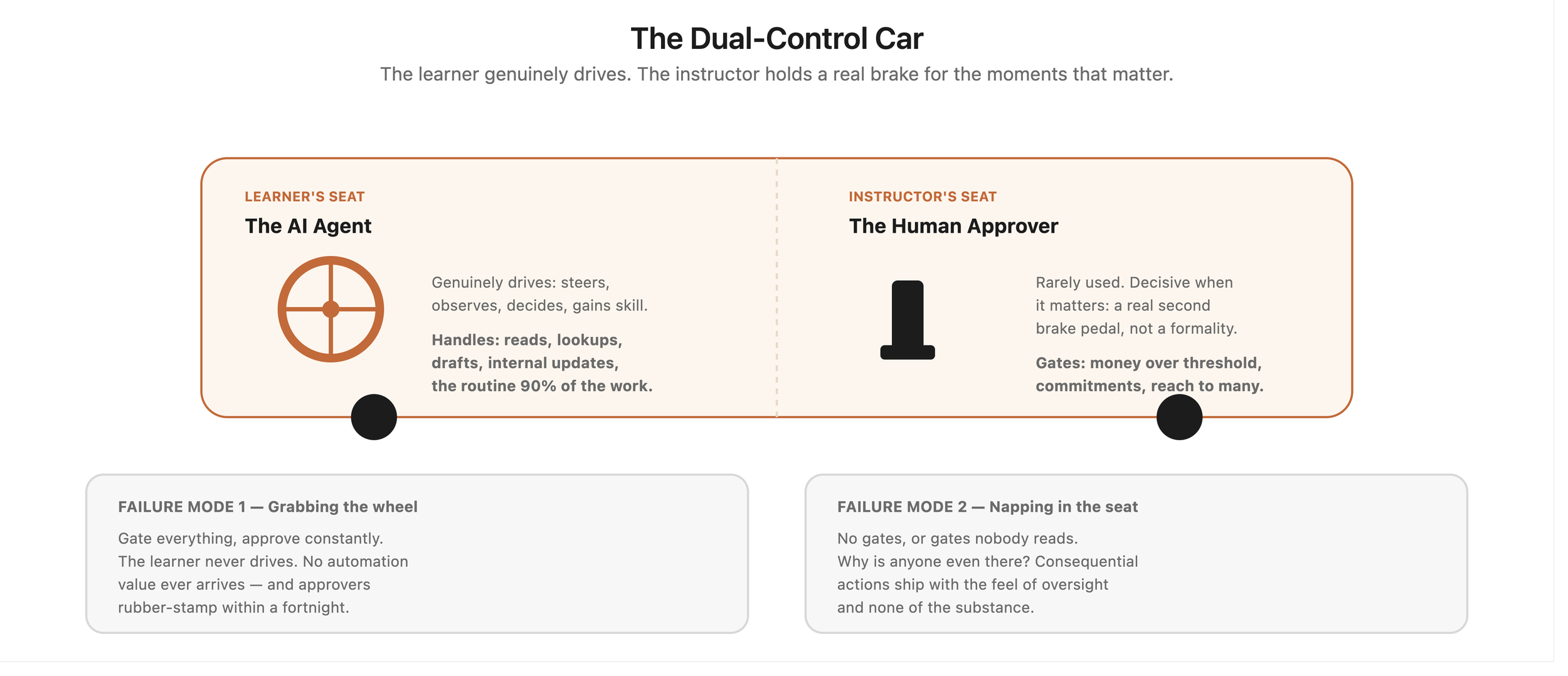
The analogy that carries the article: the driving instructor's car. A learner does the actual driving: steering, observing, deciding, gaining skill. But the instructor's side has its own brake pedal, used rarely and decisively at the moments that matter. The genius of dual controls is the balance: the learner genuinely drives (or no learning, no value), while the instructor holds real authority at the consequential moments (or no safety). Badly designed oversight fails in exactly the two ways a bad instructor does: grabbing the wheel constantly (the learner never drives, the value never arrives) or napping in the passenger seat (why are you even there?).
Human approval design is the placement of that second brake pedal: which moments, presented how, decided by whom.
Where Do the Gates Belong? The Three Categories
Across every deployment we have seen or built, the gates that earn their keep guard three categories:
Money. Refunds and payments above thresholds, pricing outside bounds, anything that moves value. The classic gate, and the easiest to set: pick the amount above which you would want a human glance even from a trusted employee, and start there.
Commitments. Contracts, bookings beyond a size, promises with legal or delivery weight. The agent drafts and prepares; a person owns the signature moment, exactly as with human staff.
Reach. Anything sent to many people at once, or to anyone when the content is sensitive: mass emails, public posts, communications touching complaints or legal matters. Individually drafted routine messages can earn auto-send; scale and sensitivity keep the gate.
The unifying principle: gate what is expensive to reverse. A wrong internal record is a correction; a wrong refund, signed contract or mass email is an incident. Reversibility, not importance, is the test, because it prices the actual downside of a mistake slipping through.
And note what is deliberately NOT gated in mature systems: reads, lookups, drafts, internal updates, and the routine bulk of the workflow. That is the learner actually driving. The [governance guide]'s agency example remains the cautionary tale: gate everything and your approvers rubber-stamp within a fortnight, which is slower AND less safe than well-chosen gates. Blanket approval is not caution; it is fatigue manufacturing.
Designing the Gate Itself: The One-Glance Rule
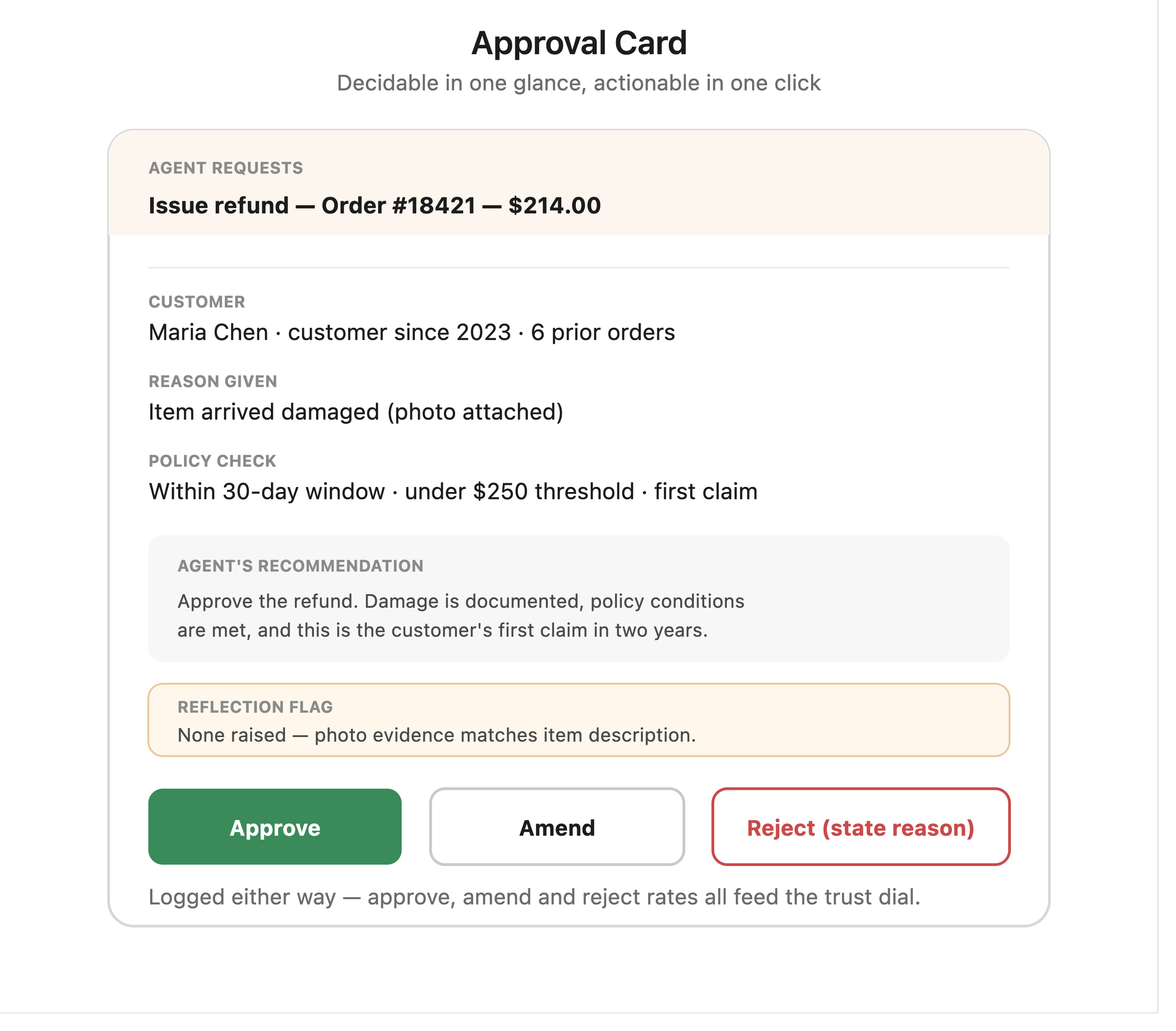
A gate is only as good as the moment it creates for the human, and that moment has a design standard: decidable in one glance, actionable in one click.
The approval card the human sees should carry: what the agent wants to do, the key facts behind it (order, history, policy clause), the agent's recommendation and its reasoning in two sentences, and any flag the [reflection] layer raised. Approve, amend, reject: one click each, with rejection asking for a reason (that reason becomes training data for thresholds and, written back to [memory], a lesson).
What kills gates in practice is friction: approvals buried in email chains, context requiring three system logins to assemble, queues nobody owns. The approval moment should be the easiest decision surface in your business, because its whole economics depend on human attention being spent in seconds, not minutes. If assembling the context takes the approver longer than the agent took to do the work, the design has failed at its own job.
Escalation is the gate's sibling, and it deserves equal design. Beyond planned approvals, the agent needs a designed path for the unplanned: the case outside its scope, the check that keeps failing, the customer who asks for a human. A good escalation arrives like a good handover: full context attached, one paragraph of "what I know and where I got stuck," routed to a named queue that someone owns. The [customer service article]'s law applies everywhere: people forgive a system that hands over quickly and gracefully; they never forgive one that traps them.
Why Should a Business Care About Gate Design Specifically?
Because gates are where trust is calibrated, in both directions. Every approval decision is data: approve rates near 100% on a category say the threshold can rise (the agent has earned it); frequent amendments say the agent needs better context or rules; rejections cluster around a pattern that becomes a new boundary. Well-logged gates are a trust dial you can turn with evidence, which is exactly how the 90-day roadmap shadow-then-loosen approach works after launch, forever.
Because regulators and buyers increasingly ask for exactly this. "What does your AI do without human sign-off?" is now a procurement and compliance question (the pillar predicted it; [HR](in hiring decisions) and [finance](in payments) live it already). A designed gate map, with logs, is a one-page answer. Its absence is a stalled deal or a finding.
Because the gates are what let everything else run fast. The counterintuitive economics: well-placed gates ACCELERATE automation, because they are what makes it safe to let the other 90% flow untouched. Businesses without designed gates end up reviewing everything informally and forever; businesses with them review little, decisively. The brake pedal is what permits the speed.
What Are the Limitations and Failure Modes?
Rubber-stamping, the great quiet killer. Overloaded or over-gated approvers stop reading and start clicking, at which point the gate provides the feeling of safety with none of the substance, which is worse than no gate because it also silences the alarm. Defences: threshold-based gating (only the consequential), queue-size monitoring (an approver seeing 40 items a day is a redesign signal), and periodic seeded tests (a deliberately flawed item now and then; if it sails through, the gate has died).
The accountability mirage. A human click on an approval does not automatically mean meaningful human judgment happened; regulators know this too. The standard that holds up: the approver had the context, the time and the authority to genuinely decide, and the logs show amendments and rejections actually occur. A gate that has never rejected anything is a decoration.
Latency where it hurts. Gates add human-speed pauses to machine-speed flows. For most SMB workflows this costs minutes and nothing else; for genuinely time-critical actions, design the gate as pre-authorisation instead (rules agreed in advance, human reviews after) or question whether an agent is the right tool at all.
Ownership decay. The named approver changes roles, the queue orphans, the gate silently backs up. Gates are living process: they need an owner, a deputy, and a place in the quarterly [governance] review like every other boundary.
A Real-World Shape
A wholesale distributor's order-desk agent processes inbound purchase orders end to end. The gate map, on one page: auto-flow for standard orders from known customers within credit limits (81% of volume); one-glance approval for orders over $5,000, any new customer, or any credit-limit touch (the sales manager's queue, averaging six cards a day, ninety seconds each); hard escalation for pricing disputes and anything the reflection checks fail twice.
Six months of gate logs told the story: approval rate on the $5,000 gate ran 97%, so the threshold rose to $8,000 with the finance director's blessing (evidence, not vibes); amendments clustered on new-customer orders missing delivery-window context, so the approval card gained a field; and two seeded test flaws were both caught, confirming the manager was still genuinely reading. The gates now govern 12% of volume, decisively, and the agent runs the rest at machine speed. That is the dual-control car working: the learner driving, the instructor alert, and everyone arriving faster because of it.
The Buyer's Human-Approval Questions
- "Show me the gate map." Which action categories pause for a person, at what thresholds, to whose queue. One page or it does not exist.
- "Show me an approval card." Is it decidable in one glance with context attached, or an email chain wearing a process costume?
- "What do the logs say?" Approve/amend/reject rates per gate: near-100% approvals mean thresholds to revisit; zero rejections ever means a decorative gate.
- "How do thresholds change?" The right answer cites evidence from the logs and a named authority, not "we can tweak it."
- "What happens when the approver is on holiday?" Deputies, queue ownership, ageing alerts. Gates without owners decay into either bottlenecks or bypasses.
Frequently Asked Questions
-
That defined categories of agent action pause for a named person's decision before executing: typically money above thresholds, commitments, and mass or sensitive communication. The agent prepares everything; the human decides in one glance; the system logs it all. Everything else runs at machine speed.
-
Gate what is expensive to reverse: payments and refunds over a threshold, contracts and large bookings, mass sends, and anything touching complaints, legal matters or regulated decisions. Leave reads, drafts and routine internal updates ungated, or you manufacture the rubber-stamping that defeats the gate.
-
Gate less (thresholds, not blankets), design one-glance approval cards with real context, monitor queue sizes (dozens a day means redesign), track amend/reject rates (zero rejections means a dead gate), and occasionally seed a deliberate flaw to test attention. Gates are living process, not furniture.
-
The opposite, when designed well: gates on the consequential 10% are what make it safe to let the routine 90% flow untouched. The distributor pattern is typical: most volume auto-flows, a manager spends ten minutes a day on the cards that matter, and thresholds rise as evidence accumulates.
-
They should: that is trust calibration working. High approval rates on a gate are evidence for raising its threshold; clustered amendments are evidence the agent needs better context; rejection patterns become new boundaries. The gate logs are the dial, and a named authority turns it.
-
Increasingly, in specific domains: automated decisions with significant effects face restrictions under GDPR-style law, employment decisions carry obligations in several jurisdictions, and financial controls have always demanded sign-off. The design standard that satisfies all of it: a person with context, time and authority genuinely decides the consequential, and the logs prove it.
-
Usually the person who used to do the task: they know the exceptions, spot the subtle wrongness fastest, and their redeployment from doing to deciding is the value the automation created. Managers make better approvers only where the decision was always theirs (credit limits, discounts beyond policy). Whoever it is, the role needs naming, a deputy, and queue-time in their actual job description, because an approval queue treated as an interruption becomes a rubber stamp within a month.
-
Fewer than instinct suggests: two or three well-chosen gates cover most single-workflow agents (a money threshold, a new-or-flagged-counterparty check, and a sensitivity catch on outbound content). Each gate should average seconds per decision and single-digit daily volumes per approver. More gates than that on one workflow usually signals a scope too broad for one agent, or thresholds set from anxiety rather than from the reversibility test.
The Takeaway
Human approval is the dual-control car: the agent drives, genuinely and increasingly well, while a person holds a real brake at the moments that are expensive to reverse. Gate money, commitments and reach; design the approval moment for one glance and one click; read the logs and turn the trust dial with evidence; and keep every gate owned, tested and alive.
It is the last component of the anatomy and the one that makes the whole worth deploying, because the question every stakeholder eventually asks (what does this thing do without a human?) deserves what the best deployments have: a one-page answer, a clean log, and an approver who is demonstrably still awake.
Bots and Brand Works builds single agents that earn their teams: maker-checker pairs, orchestrated specialists, full traces, honest per-outcome costs. If a multi-agent pitch has you wondering whether it is architecture or theatre, send it over and we will read the org chart for you.
Need help implementing AI Solutions?
Resources and Further Reading
- Pillar article: Agentic AI vs Workflow Automation: The 2026 Enterprise Guide
- Related: AI Agent Governance
- Related: Reflection Explained
- Also in this series: What Is Agentic AI? · What Is an AI Agent? · Tool Calling
- [Anthropic: Building effective agents:] Click Here
- [UK ICO guidance on automated decision-making:] Click Here