

Multi-Agent Systems Explained: When One AI Worker Becomes a Team
Multi-agent systems put specialist AI agents to work as a team: orchestrators, specialists and reviewers cooperating on goals too big for one agent. How they work, when they beat a single agent, and when they are overkill.
Once you understand what one AI agent is, a question arrives naturally: if one agent can process a return, could five agents run a whole department?
The industry's answer is multi-agent systems, and it comes wrapped in the year's most seductive demos: AI "companies" with AI researchers briefing AI writers reviewed by AI editors, org charts made of software. Some of it is genuinely the frontier of what works. Some of it is a single agent's workload split five ways for the applause.
This guide covers the real thing: what multi-agent systems are, the three patterns that actually ship, when a team genuinely beats a lone agent (and the honest cases where it does not), the coordination problems that make these systems harder than they look, and how a small business should approach the whole idea.
(Prerequisite reading if the anatomy is fuzzy: What Is an AI Agent?. The pillar's strategic frame is in Agentic AI vs Workflow Automation.)
What Is a Multi-Agent System?
A multi-agent system is several AI agents, each with its own role, tools and boundaries, cooperating on a goal too big or too varied for one agent to handle well. Instead of one generalist doing everything adequately, you get specialists doing their piece well, with structure deciding who does what and when.
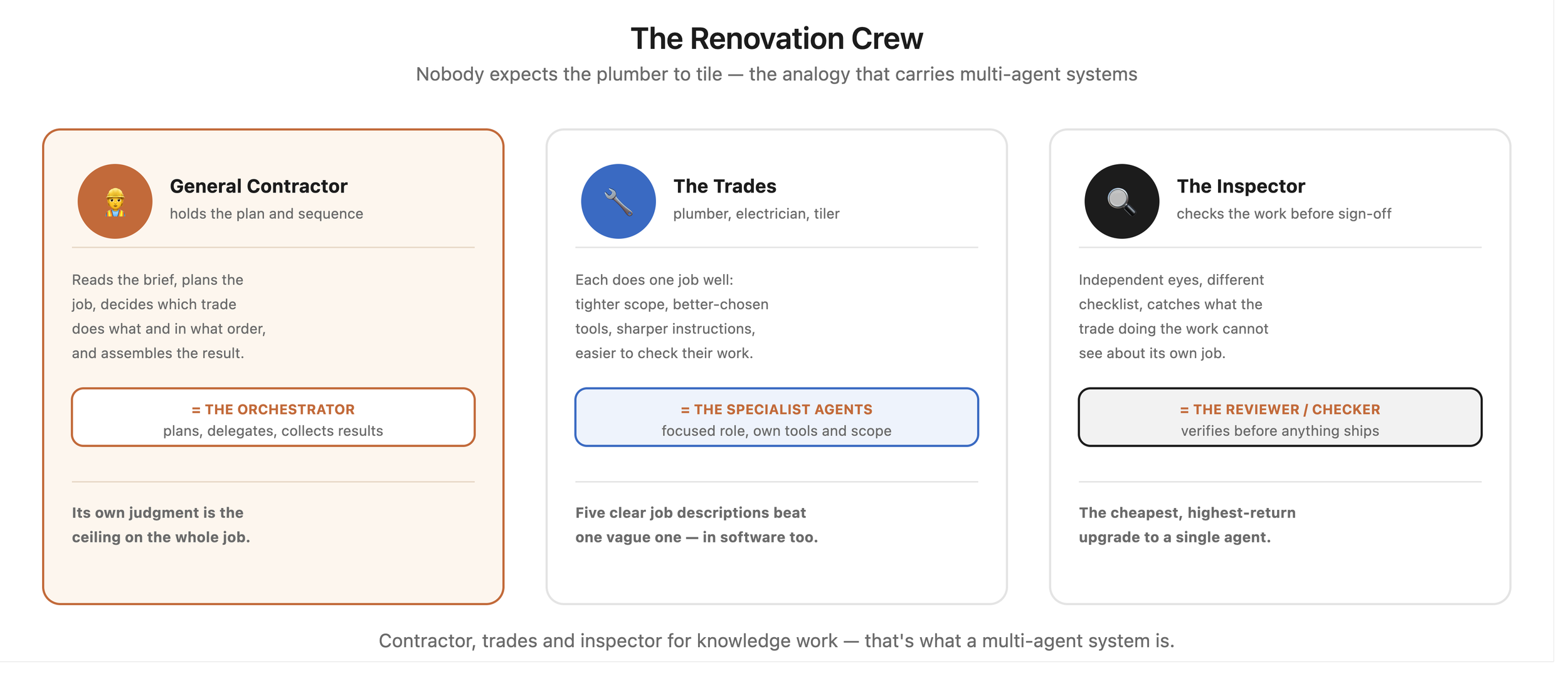
The analogy that carries the article: a house renovation. You could hire one talented all-rounder to do the plumbing, wiring, plastering and tiling: fine for a small job, slow and error-prone for a big one. A real renovation runs differently: a general contractor holds the plan and sequence, specialist trades do what they are best at, and an inspector checks the work before sign-off. Nobody expects the plumber to tile. Multi-agent systems are exactly this: a contractor (orchestrator), trades (specialist agents) and an inspector (reviewer), for knowledge work.
Why specialists beat a generalist here is worth one plain sentence: an agent is its job description ([anatomy refresher](the five components are built around a role)), and a focused role means a tighter scope, better-chosen tools, sharper prompts and easier testing. Five clear job descriptions routinely outperform one vague one, in software as in renovations.
The Three Patterns That Actually Ship
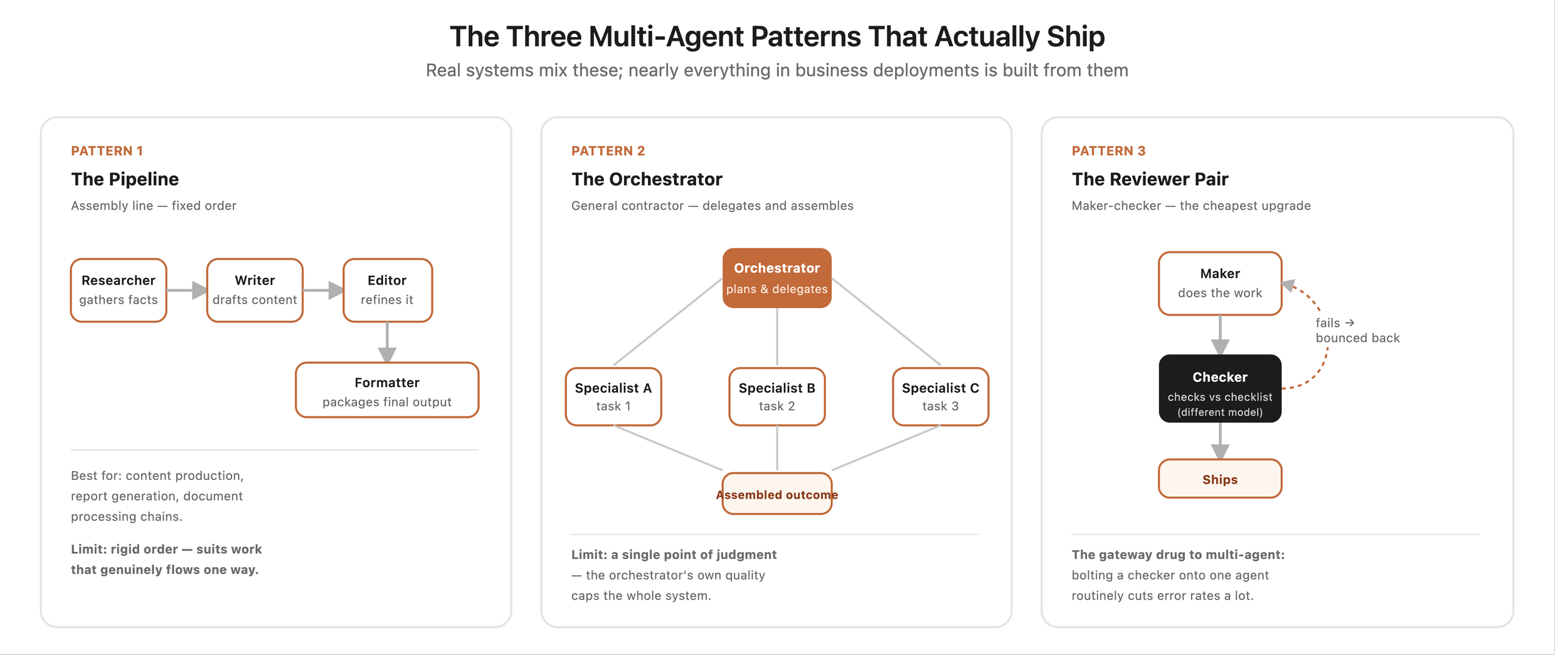
Multi-agent architectures come in endless academic flavours; in business deployments, three patterns cover nearly everything.
Pattern 1: The pipeline (assembly line). Agents in sequence, each transforming the work and passing it on: researcher → writer → editor → formatter. Simple to reason about, easy to monitor (inspect the hand-offs), and the right shape for content production, report generation and document processing chains. Its limit: rigid order, so it suits work that genuinely flows one way.
Pattern 2: The orchestrator (general contractor). One coordinator agent holds the goal, breaks it into tasks ([planning, covered next in the series]), delegates to specialists, collects results and assembles the outcome, re-delegating when a piece comes back wrong. This is the workhorse pattern for complex, branching work: research briefs, due diligence, complex customer cases. Its limit: the orchestrator is a single point of judgment, so its own quality caps the system.
Pattern 3: The reviewer pair (maker-checker). One agent does; a second agent, with different instructions and often a different model, critiques against a checklist before anything ships: accuracy, policy compliance, tone. The cheapest multi-agent upgrade there is, and the gateway drug to the whole field, because bolting a checker onto an existing agent routinely cuts error rates dramatically. (This is [reflection] built out into a second set of eyes.)
Real systems mix the patterns: an orchestrator running a pipeline with a checker at the end is the standard shape of a serious deployment. Frameworks divide along these lines too: CrewAI leads with role-based teams, LangGraph with explicit orchestrated flows, the OpenAI Agents SDK with lightweight hand-offs; the comparison lives in our [AI automation stack] guide.
When Does a Team Beat a Lone Agent?
Honest criteria, because the demos will not give you any.
The work has genuinely different modes. Researching, writing and checking reward different instructions, different tools, even different models. When one agent's job description needs three personalities, it is three agents.
The task exceeds one context. Very long documents, many sources, sprawling goals: splitting across specialists keeps each agent working within a window where it is sharp.
You need internal quality control. Maker-checker catches what a single agent cannot see about its own output, for the same reason writers need editors.
Parallelism pays. Fifteen suppliers to research: fifteen parallel specialist runs beat one sequential slog.
And the honest counter-list. A single well-scoped agent beats a team when the task is one coherent job; adding agents adds hand-offs, and every hand-off is a place to lose context, add latency and multiply cost. The uncomfortable truth behind several glossy demos: a five-agent system doing what one good agent could do is not architecture; it is theatre with a token bill. Start with one agent; earn the team.
The Coordination Problems Nobody Demos
Multi-agent systems inherit every problem of single agents, plus the ones that come with teamwork.
Context loss at hand-offs. The researcher knows why a detail matters; the summary it passes forward may not say. Like any relay, the baton matters more than the runners: hand-off design (what exactly gets passed, in what structure) is where these systems are won and lost.
Error propagation. A wrong "fact" from agent one becomes the confident foundation of agents two through five. Without checkpoints, teams launder errors into consensus. This is why the reviewer pattern is not optional at scale, and why [human approval] gates sit at the consequential exits.
Cost multiplication. Every agent thinks in tokens, and orchestration adds its own thinking. A five-agent run can cost ten times a single-agent run; worth it for the right work, ruinous for the wrong work. Budget per outcome, not per agent, and monitor from day one.
Debugging in a hall of mirrors. "The output is wrong" now has five suspects and their interactions. Production multi-agent systems live and die by observability: full traces of who did what, with what input, producing what. If a vendor cannot show you a trace, they cannot maintain what they are selling.
Governance multiplies too. Each agent needs its own scoped permissions and boundaries; the [governance mechanics] apply per team member, exactly as with human staff. The upside: done right, a well-governed team is SAFER than a monolith, because each specialist holds fewer keys.
What Does a Team Run Actually Cost? A Worked Miniature
Because "cost multiplication" deserves numbers, here is the agency brief from below, priced.
A single-agent version of the competitor brief: one agent, one long run, roughly 150,000 tokens of reasoning and drafting across the task. At typical 2026 model pricing, call it $1.50 to $3 per brief, depending on model tier.
The five-agent version: the orchestrator's planning and coordination (estd. 40,000 tokens), three researchers in parallel (esyd. 60,000 each, but on a cheaper model tier, since gathering is easier than judging), the synthesis agent on the premium tier (estd. 80,000), and the checker re-verifying claims against sources (estd. 50,000). Total: roughly $6 to $12 per brief.
So the team costs three to four times the soloist per run. The relevant comparisons, though, are these. Against the analyst it replaces: two analyst-days at loaded cost is $300 to $500, so both architectures are rounding errors beside the labour, and the team's better output (checked claims, deeper research) is worth its premium many times over. Against a failed brief: one unsupported claim reaching a client costs more than a year of checker tokens.
Where the maths flips: high-volume, low-value tasks. A five-agent ceremony on a task worth $2 of human time is theatre with a token bill, which is exactly why the [hybrid stack] keeps such work on deterministic rails and reserves teams for work whose value carries the thinking cost.
The budgeting rule that falls out: price per completed outcome, compare against the human alternative and the single-agent alternative, and let volume decide. Any multi-agent proposal that quotes only monthly platform fees, without a per-outcome token estimate, has skipped the only number that matters.
A Real-World Shape
A marketing agency's competitor-brief system, built after their single "research agent" kept producing shallow results on big briefs. The team: an orchestrator that parses the client brief and plans; three parallel researcher agents (market data, competitor content, pricing signals) with read-only web and database tools; a synthesis agent that drafts the brief; and a checker agent with one job: verify every claim against the researchers' sources and flag anything unsupported.
Results: brief production went from two analyst-days to forty minutes plus a human review hour; the checker catches roughly one unsupported claim per brief (which is the system working, not failing); and cost per brief runs a few pounds in tokens against hundreds in analyst time. The failure that taught them the most: early versions lost nuance at the researcher-to-synthesis hand-off until they restructured what researchers passed forward: findings WITH sources and confidence notes, not summaries. The baton, not the runners.
How Should a Small Business Approach Multi-Agent?
Step 1: Deploy one agent well first. Bounded goal, full anatomy, measured results (the 90-Day Roadmap path). Multi-agent problems are single-agent problems multiplied; earn the fundamentals.
Step 2: Add a checker, not a crew. The maker-checker pair is the lowest-risk, highest-return entry: same workflow, one new agent, visibly better output. If this does not improve your results, a bigger team will not either.
Step 3: Let the work demand the team. Move to orchestrated specialists only when a real task shows the criteria above: different modes, oversized context, parallelism. The tally-and-baseline discipline applies unchanged.
Step 4: Insist on traces and per-outcome cost. Before any multi-agent build: show me the trace of a full run, and the token cost per completed outcome. Those two artefacts separate builders from demo artists.
Step 5: Keep humans at the exits. However many agents cooperate inside, consequential outputs leave through the same doors: [approval gates], audit trails, escalation paths. The team is internal machinery; the accountability structure does not change.
Frequently Asked Questions
-
Several AI agents with distinct roles cooperating on one goal: typically an orchestrator that plans and delegates, specialists that execute their piece, and often a reviewer that checks work before it ships. A renovation crew (contractor, trades, inspector) rather than one all-rounder.
-
When the work has genuinely different modes (research vs writing vs checking), exceeds what one agent can hold in context, benefits from parallel runs, or needs built-in quality control. If the task is one coherent job, one well-scoped agent is better: cheaper, faster, easier to debug.
-
With a reviewer pattern and good hand-off design, meaningfully yes: a second set of instructions catches what the maker cannot see. Without those, they can be LESS reliable, because errors propagate and context leaks at every hand-off. The architecture, not the headcount, decides.
-
Build costs sit at the top of custom-agent territory (our [pricing guide]'s upper tiers), and running costs multiply with every thinking member: a team run can cost several times a single-agent run. Price per completed outcome against the human alternative, and insist on cost monitoring from day one.
-
CrewAI popularised role-based teams; LangGraph expresses explicit orchestrated workflows with checkpoints; the OpenAI Agents SDK does lightweight agent hand-offs. The philosophies differ more than the capabilities; our [AI automation stack] guide compares them for business buyers.
-
No. It is ordinary agents with good job descriptions and designed hand-offs: closer to a well-run project team than to any science-fiction autonomy. The "AI employees running an AI company" framing is marketing; the renovation crew is the reality, and the reality is useful enough.
-
Yes, and good builds usually do: cheaper, faster models for gathering and routine steps, premium models for synthesis and judgment, and ideally a different model family for the checker (different blind spots catch more). Model routing is one of the quiet economics levers of team design: the agency example's researchers run at a fraction of the synthesis agent's per-token cost. When evaluating a build, "which model does each role use, and why?" is a question that separates deliberate architecture from default settings.
-
By design, not democracy: the orchestrator owns the decision when specialists conflict, checkers can block but not rewrite, and persistent disagreement (a checker rejecting twice, researchers returning contradictory facts) escalates to a human with both sides attached. That escalation rule matters more than any voting scheme: work the team cannot agree on is precisely the work a person should see, and a system that forces internal consensus instead is laundering uncertainty into false confidence.
The Takeaway
Multi-agent systems are teamwork applied to software: contractor, trades and inspector instead of one heroic all-rounder. Genuinely better when the work has modes, scale or parallelism; genuinely worse when one agent would do, because hand-offs cost context, money and debuggability.
Earn the team the way businesses always have: one good worker first, then a checker, then specialists as the work demands, with traces you can read and humans at the exits. The org chart made of software is real. It just has to be earned like any other org chart.
Bots and Brand Works builds single agents that earn their teams: maker-checker pairs, orchestrated specialists, full traces, honest per-outcome costs. If a multi-agent pitch has you wondering whether it is architecture or theatre, send it over and we will read the org chart for you.
Need help implementing AI Solution?
Resources and Further Reading
- Agentic AI vs Workflow Automation: The 2026 Enterprise Guide
- Related: What Is an AI Agent? The Anatomy
- Related: Agent Planning Explained
- Also in this series: Reflection · Human Approval
- CrewAI documentation: Click Here · LangGraph: Click Here · OpenAI Agents SDK: Click Here
- Anthropic: Building effective agents: Click Here