

The 90-Day AI Adoption Roadmap for Small Businesses
How to implement AI in a small business without a transformation programme: a week-by-week 90-day roadmap from first audit to first measured win, with the decision gates that keep you out of the failure statistics.
There are two popular ways to adopt AI in a small business, and both fail.
The first is the transformation programme: a grand strategy, a steering committee, seven simultaneous pilots, and eighteen months later a folder of slide decks and no measured result. The second is the drift: someone gets a ChatGPT subscription, three tools get trialled and abandoned, everyone "uses AI a bit," and nothing in the P&L ever notices.
The path that works is narrower and shorter than either: ninety days, one function, one workflow, one measured win. Then repeat, on plumbing you have already paid for. This roadmap is that path, week by week, with the decision gates that separate businesses that compound AI value from the ones Gartner counts in the 40% of cancelled projects.
(This is the practical companion to [AI for Every Business Function], which covers WHERE AI helps; this covers HOW to get there.)
Why Ninety Days?
Because ninety days is long enough to build something real and short enough to stay honest.
Shorter horizons only allow tool subscriptions, which change individual productivity but never processes. Longer horizons invite scope creep, committee-thinking and the fatal drift from "automate invoice intake" to "reimagine our operations," which is how projects join the statistics. Ninety days forces the discipline that every post-mortem of failed AI projects wishes had existed: narrow scope, measured baseline, visible finish line.
One framing rule before the weeks begin: your first project should be boring. Internal rather than customer-facing, repetitive rather than clever, measurable rather than impressive. Boring is where the money is, and boring is where trust gets built cheaply. (The full argument, with the failure patterns it avoids, is in [Why 40% of AI Agent Projects Fail].)
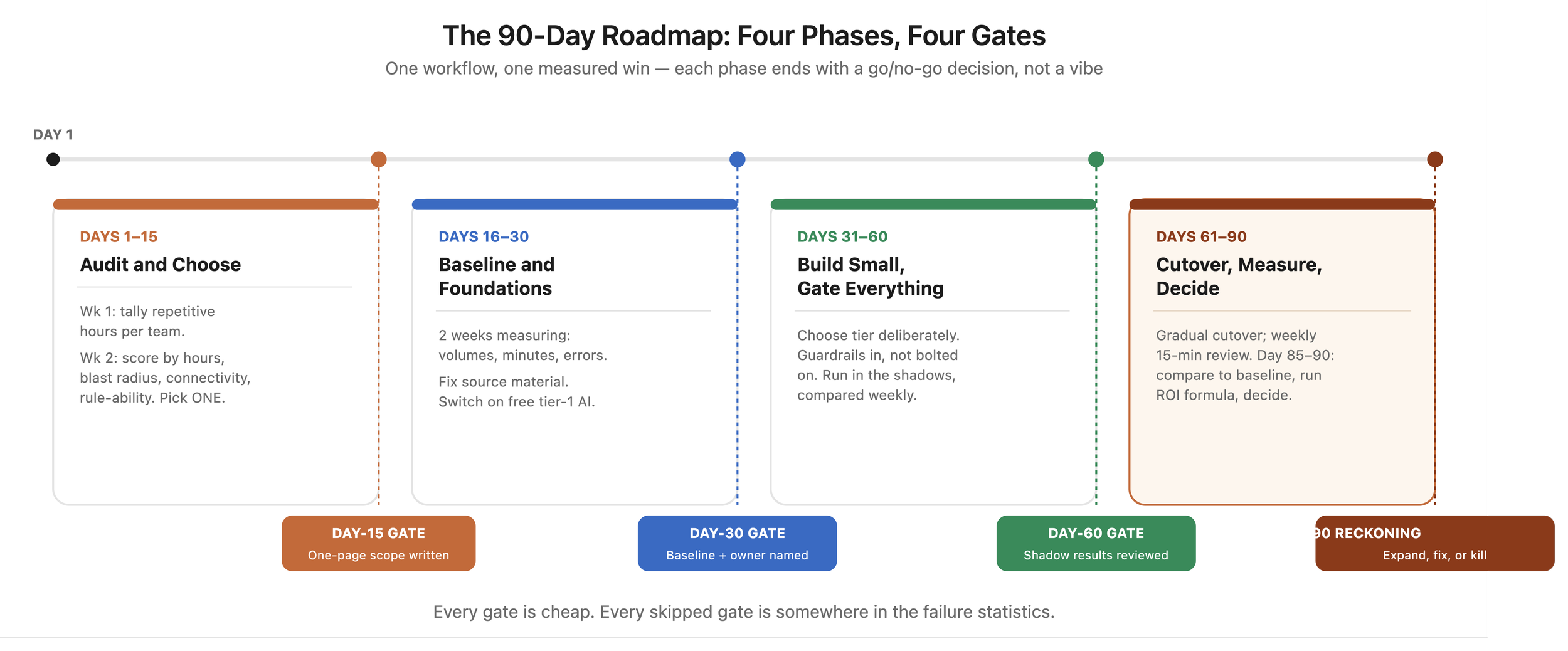
Days 1 to 15: Audit and Choose
Week 1: find the repetitive hours. Have each team keep a simple tally for one week: which tasks repeat, how many minutes, how often. No software needed; a shared sheet works. You are hunting for the workflows that are high-volume, rule-ish, and currently done by a sighing human. Every function has them; [AI for Every Business Function] lists the usual suspects per department.
Week 2: score the candidates and pick one. Score each candidate workflow on four things:
- Hours consumed per month (bigger is better)
- Blast radius if it goes wrong (smaller is better: internal beats customer-facing, information beats money)
- Connectivity (do the systems involved have APIs or MCP servers? cheap to check, decisive for cost; our [MCP guide] explains why)
- Rule-ability (can you describe how the task is done on one page? If nobody can, it is not ready)
Pick the winner. One. The runner-up is your second quarter, not your parallel pilot.
The Day-15 gate: you have a one-page scope: the workflow, its boundaries, its exceptions, its monthly hours, and a numeric success target ("reduce manual intake time 60% by day 90"). If you cannot write this page, you have not finished the audit. Do not proceed without it; this page is the single best predictor of success in the whole roadmap.
Days 16 to 30: Baseline and Foundations
Measure before you build. Two weeks of counting the chosen workflow: volumes, minutes per task, error rates, response times. Unmeasured projects cannot prove value later, and unprovable projects get cancelled in budget season regardless of whether they worked. The [ROI guide] shows the exact numbers to capture and the formula they feed.
Fix the source material. If the workflow involves documents or policies (most do), update them now: current prices, one version of each policy, tribal knowledge written down. AI grounded in stale documents automates misinformation politely.
Switch on the free layer while you wait. The AI features inside tools you already pay for (CRM summaries, email drafting, meeting notes) cost nothing to enable and start the team's habit-building. This is tier 1 of the [pricing guide], and every business should be here regardless of the project.
The Day-30 gate: baseline documented, source material current, success number agreed with whoever owns the budget. A named internal owner exists: one person who will read the outputs weekly and care. Projects owned by "the team" fail; projects owned by Priya survive.
Days 31 to 60: Build Small, Gate Everything
Choose the tier deliberately. Match the build to the workflow, not the ambition: many first projects need only configured no-code automation (tier 2); document-heavy ones need an extraction flow; question-answering ones need a grounded assistant (the [RAG pattern]). Custom agents come later, on evidence. If a vendor proposes tier 4 for your first project, that is a sales strategy, not an implementation strategy.
Build with the guardrails in, not bolted on. Whatever the tier: least-privilege access to systems, human approval on anything that touches money or leaves the building, logging from day one, and an exception path to a human. This is the one-page version of [AI Agent Governance], and it costs almost nothing at build time.
Run it in the shadows. For the last stretch of this phase, the automation works alongside the existing manual process, not instead of it. Outputs compared weekly. This is where you calibrate trust with evidence instead of vibes, and where the misreads and edge cases surface while they are free.
The Day-60 gate: shadow results reviewed. Accuracy acceptable against the baseline? Exceptions landing in the queue rather than slipping through? If yes, proceed to cutover. If no: fix and extend the shadow period. A wobbly automation promoted on schedule becomes a cancelled automation by Christmas; the calendar serves the quality, not the reverse.
Days 61 to 90: Cutover, Measure, Decide
Cut over gradually. The automation takes the workflow; humans take the exception queue and spot-check samples weekly. Keep the old manual process documented and revivable for a month (your rollback is a document, not a prayer).
Hold the weekly review. Fifteen minutes, every week, non-negotiable: transcripts or samples read, exception queue checked, costs glanced at. Most automation failures are slow leaks that a weekly glance catches in week two instead of month six.
Day 85 to 90: the reckoning. Compare against baseline in CFO-readable numbers: hours saved, error rates, response times, cost. Run the [ROI formula] honestly, realisation discount included. Then make the explicit call: expand, fix, or kill. All three are legitimate outcomes; the only illegitimate one is drifting on without deciding.
Then repeat. The second 90-day cycle picks the runner-up workflow, and here the economics turn in your favour: the connections, the habits, the governance template and the review rhythm all exist. Second projects routinely cost half the first and land in half the time. This compounding is the actual prize of the roadmap: not one win, but a repeatable machine for producing them. (Architecturally, you are building toward the [Hybrid Automation Stack], one proven piece at a time.)
The Second Ninety Days: Where Compounding Lives
The roadmap's real payoff is not the first win; it is what the first win makes cheap. A quick map of cycle two, because knowing it changes how you build cycle one.
The plumbing is paid for. Connections to your CRM, accounting system or helpdesk built for project one serve project two free (build on open standards like MCP and this compounding is strongest; the [MCP guide] explains why). Budget accordingly: second builds routinely land at half the first quote, and vendors who re-quote full integration for connected systems deserve the question.
The governance template exists. Your one-page scope format, approval-gate patterns, review rhythm and audit habits copy across in an afternoon. What took a fortnight of figuring-out in cycle one is now a checklist.
The team has instincts. Cycle one taught your people what AI gets wrong and how exceptions flow. Cycle two's shadow period can safely be shorter because the reviewers know what to look for.
The candidates are already ranked. Your day-15 audit produced runners-up; cycle two starts at day 16, not day one. Most businesses alternate function types deliberately: a document automation, then a grounded assistant, then a bounded agent, building the [three-role portfolio](the assistant-analyst-agent ladder) piece by proven piece.
By the third or fourth cycle, something structural has happened: you are no longer running AI projects; you are operating a rhythm. New automation requests get triaged against the same four scores, built on the same rails, reviewed in the same fifteen minutes. That rhythm, not any single automation, is the moat, because competitors can buy your tools but not your operating habit.
What Are the Traps in the Roadmap Itself?
The parallel-pilots temptation. Two workflows at once means two half-measured, half-owned projects. The discipline of one is the roadmap's entire mechanism; break it and you have the transformation programme again, in miniature.
The demo-driven detour. Mid-roadmap, someone will see an impressive tool and propose switching horses. Log it for next quarter. The roadmap runs on the audit's numbers, not the demo's applause.
Skipping the boring gates. Every gate (the one-pager, the baseline, the shadow review, the reckoning) exists because its absence is a documented failure pattern. Teams under time pressure skip gates; teams that skipped gates appear in the statistics.
Forgetting the humans mid-change. The person whose task is being automated should be in the project from week one, ideally as its owner: they know the exceptions, and their redeployment (to the work that needs judgment) is the actual value being created. Automation done TO a team fails socially even when it works technically.
Stopping after one win. The first project pays back; the compounding pays off. Businesses that run the cycle quarterly wake up in eighteen months with an operations layer their competitors quote against and cannot match.
A Real-World Shape
A 25-person professional services firm ran exactly this roadmap. Audit found the winner fast: client intake, four hours per client across forms, emails and system entry, ~20 clients a month. Day-15 one-pager set the target: 60% time reduction, zero client-visible errors.
Baseline: 80 hours a month, 6% rework rate. Build: tier-2 intake automation with document extraction, human approval on everything for the shadow month. Shadow surfaced two edge cases (overseas clients, one legacy form) that became exception rules. Cutover in week nine.
Day-90 reckoning: 71% time reduction, rework under 1%, payback in eleven weeks by the [ROI formula]. Decision: expand. The second cycle (proposal drafting) reused the plumbing and landed in six weeks. The managing partner's summary: "The roadmap's secret is that it is mostly permission to do less, properly."
Frequently Asked Questions
How should a small business start with AI? One 90-day cycle: audit the repetitive hours, pick one boring high-volume workflow, baseline it for two weeks, build the smallest version with guardrails, shadow-run it, cut over, and measure against baseline. Then repeat. Tool subscriptions alone change individuals; the cycle changes the business.
What is the best first AI project? Boring, internal, bounded, measurable: document intake, invoice chasing, a grounded internal assistant, CRM auto-updating. Customer-facing and money-touching projects are second-cycle material, earned by a first win. [AI for Every Business Function] ranks candidates per department.
How much does the first 90 days cost? Often surprisingly little: tier 1 is free-to-cheap (features you already pay for), and typical first builds land in tier 2 to low tier 3 of the [pricing guide]: hundreds to low thousands. The audit and baseline cost only attention, and they are the highest-ROI fortnight in the whole plan.
Do we need an AI strategy before starting? You need a one-page scope and a success number, which is more strategy than most transformation programmes ever operationalise. The grand strategy emerges from compounding measured wins, not the other way round. Start narrow; strategise from evidence.
What if the 90-day project fails? Then the roadmap worked: you spent one quarter and a small budget learning that this workflow, this tier or this vendor was wrong, with the baseline to prove it, instead of discovering the same thing publicly at ten times the cost. Kill, keep the plumbing and the lessons, and run the cycle again on the runner-up.
Who should own AI adoption in a small business? One named person per project (usually whoever owns the process being automated), plus whoever owns the budget at the gates. Committees review; owners deliver. The weekly fifteen-minute review is the entire ongoing time commitment, and it is the highest-leverage meeting in the building.
Should we run the roadmap ourselves or with a partner? Both work; the difference is speed and scar avoidance. Self-run suits teams with a technically comfortable owner and tier 1-2 projects: the gates protect you from most mistakes. A partner earns their fee at three points: the connectivity check (they know which integrations are genuinely cheap), the build tier decision (the most expensive place to be wrong), and the shadow-period tuning. Either way, the audit, the baseline and the ownership stay in-house; outsourcing those outsources the learning, which was half the point.
The Takeaway
AI adoption fails at the extremes: the grand programme that measures nothing and the casual drift that changes nothing. The middle path is almost embarrassingly simple: ninety days, one workflow, four gates, one measured win, repeat.
Audit the hours, write the one-pager, baseline before building, build small with the guardrails in, shadow before trusting, and hold the reckoning on day ninety. Every gate is cheap; every skipped gate is somewhere in the failure statistics. And the real prize arrives quietly in cycle two, when the plumbing is paid for and the second win costs half the first. That is not a transformation programme. It is better: a habit.
Bots and Brand Works runs this exact roadmap with clients: we do the audit and the maths, build the boring thing properly, and hand you the reckoning in numbers on day ninety. Want the roadmap as a one-page checklist to run yourself? Ask and we will send it, no call required.
Need Help Implementing AI?
Resources and Further Reading
- Pillar article: [AI for Every Business Function]
- Related: [How to Calculate AI Automation ROI]
- Related: AI Readiness Checklist
- Also useful: Why 40% of AI Agent Projects Fail · Agentic AI vs Workflow Automation