

AI for Customer Service: Deflection Without the Backlash
AI can resolve most support tickets, and if mishandled, it can enrage the customers who matter most. The complete SMB guide: grounded assistants, triage, full-resolution agents, the Klarna lesson and a 90-day plan.
Customer service is where AI's promise and AI's reputation problem live in the same inbox.
The promise is real: most support volume is the same questions on repeat, the answers live in your documents, and speed is most of what customers want. That is AI's exact shape, which is why support is the most proven AI deployment in business.
The reputation problem is also real: everyone reading this has fought a chatbot that stood between them and a human like a nightclub bouncer with a script. Deployed badly, support AI does not just fail to help; it actively manufactures angry customers out of neutral ones.
The difference between those outcomes is not the technology. It is design: what you automate, what you escalate, and how honestly the machine hands over when it is out of its depth. This guide covers the whole picture: the three roles AI plays in support, the use cases with proven returns, the most instructive failure in the industry, and a 90-day plan that gets the deflection without the backlash.
(This deep dive expands the customer service chapter of AI for Every Business Function.
What Does AI Actually Do in Customer Service?
The assistant: making human agents faster. Drafting replies for agents to edit, summarising a six-month ticket history in five seconds, suggesting the relevant policy, translating on the fly, and coaching tone. Every human agent becomes their best self on their best day, with none of the customer-facing risk of full automation.
The analyst: reading all the tickets nobody has time to read. Clustering tickets into themes ("returns confusion doubled since the website change"), tracking sentiment, spotting the emerging problem while it is five tickets old instead of five hundred. Support data is the richest customer research your business owns, and almost nobody reads it. The analyst does.
The agent: resolving whole categories end to end. Order status, returns within policy, booking changes, product questions: grounded in your documentation, connected to your systems, resolving around the clock. This is the deflection everyone wants, and the layer where design quality decides everything.
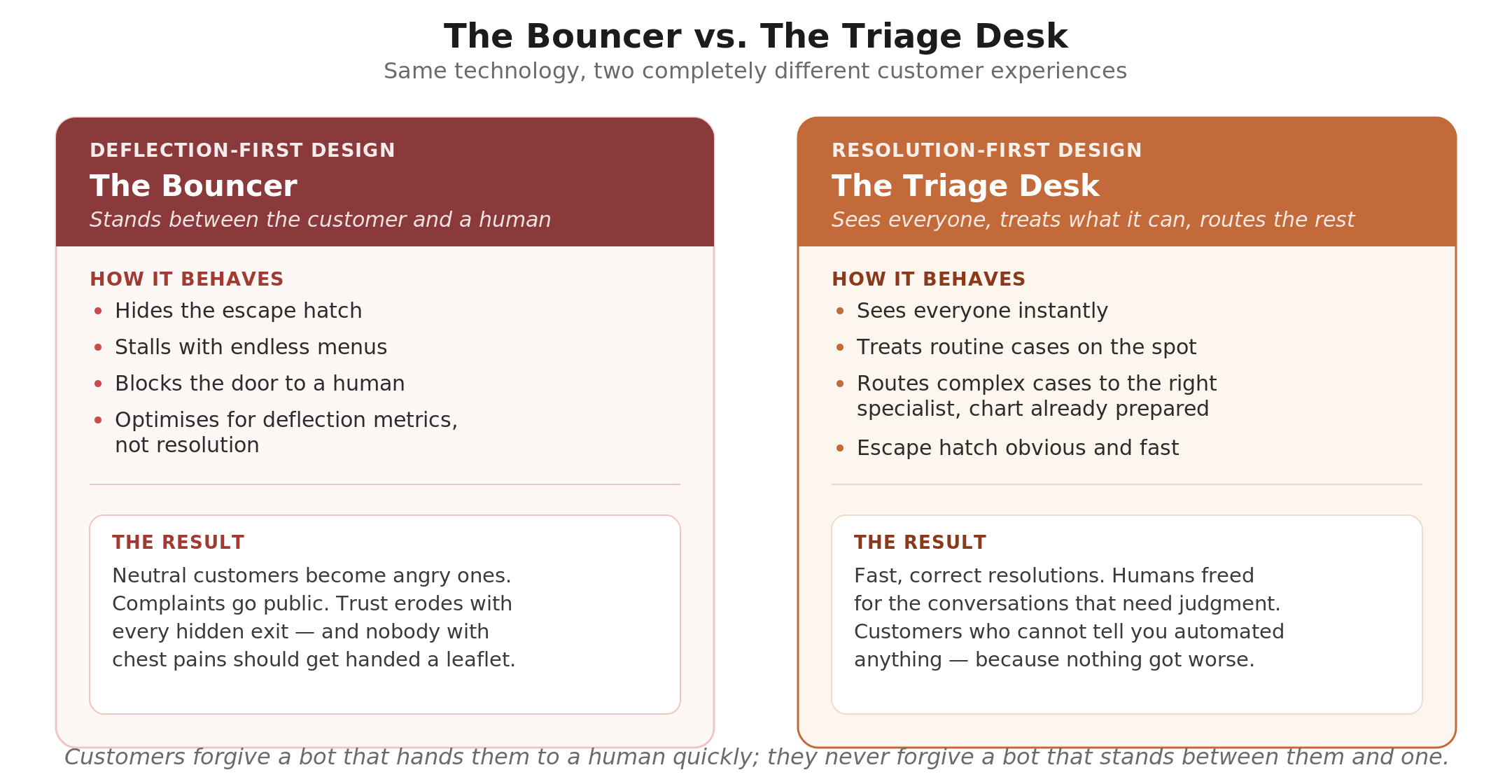
The analogy: a well-run AI support setup is a hospital triage desk, not a bouncer. Everyone gets seen instantly; the routine cases are treated on the spot; the complicated ones are routed to the right specialist with their chart already prepared. Nobody is turned away, and nobody with chest pains gets handed a leaflet.
Why Should a Business Care?
Because the economics are the best in all of business AI. Support is high-volume, repetitive and document-answerable: the grounded assistant that deflects 40 to 60% of routine tickets is the closest thing to a sure bet in this field, which is why it appears in every list of proven, ROI-verified deployments.
Because speed is most of satisfaction. Customers rate instant, correct answers above almost everything else. An AI that answers "where is my order?" with the actual order status at 11pm beats a brilliant human reply at 10am tomorrow.
Because your humans are wasted on the repetitive layer. The twenty questions that fill most inboxes teach your team nothing and burn them out steadily. Deflecting them is not cutting service; it is reserving humans for the conversations where a human matters: the upset customer, the complex case, the save-the-relationship moment.
The Use Cases Earning Their Keep
The grounded FAQ and policy assistant. Answers from your actual documentation with sources cited, and the crucial instruction to say "I don't know, let me connect you" rather than improvise (the RAG pattern; the full mechanics are in [Vector Databases and RAG Explained]). This is the fastest proven win in the function.
Intelligent triage. Every incoming message classified, prioritised, sentiment-checked and routed with a summary attached, so human agents start every ticket halfway done. Invisible to customers, transformative for queues.
The full-resolution agent for bounded tasks. "Where is my order?" answered with the real order status. Returns within policy processed end to end. Bookings moved. Each of these is a narrow, well-bounded workflow, which is exactly what agents are good at, with authority limits and escalation designed in ([AI Agents vs Chatbots] draws the line; [AI Agent Governance] builds the fence).
Agent-assist for the human team. Draft replies, history summaries, policy lookups inside the helpdesk. The most underrated deployment: all of the speed, none of the customer-facing risk, and the perfect first step for cautious teams.
The theme report. A monthly analyst pass over every ticket: top themes, rising complaints, exact customer phrasing. This output belongs in product and marketing meetings, not just support ones.
The Klarna Lesson: The Whole Playbook in One Story
No support AI conversation is complete without it. Klarna's assistant famously did the work of around 850 human agents, with roughly $60M in annual savings reported. Then, in May 2025, Klarna began rehiring humans after customers pushed back on generic answers and mishandled edge cases, with the CEO conceding the cuts went too far.
Read carefully, because both halves are true: the AI genuinely handled enormous volume, and fully removing humans from judgment-heavy, brand-sensitive conversations was a step too far even for a company with world-class engineering. Klarna did not abandon the AI; it rebalanced to a hybrid.
The transferable rules: machines for volume, humans for judgment. Escalation designed, not improvised. And the sentence every SMB should tape to the wall: customers forgive a bot that hands them to a human quickly; they never forgive a bot that stands between them and one.
What Are the Limitations and Traps?
The bouncer trap. Hiding the escape hatch ("no, I really need a human") to protect deflection metrics is the fastest way to convert neutral customers into public detractors. The escape hatch should be obvious, fast, and carry the conversation context with it, so nobody repeats their story.
Confident wrongness. An ungrounded bot will invent a returns policy cheerfully. Grounding in your real documents plus the "say when you don't know" instruction is non-negotiable for anything customer-facing, and monitoring catches the drift (weekly transcript reviews, per the [governance guide]).
Stale knowledge. The assistant answers from your documentation, so outdated documentation now misleads customers at scale, politely. Someone owns keeping the source documents current; that ownership is part of the deployment, not an afterthought.
Measuring deflection instead of resolution. A ticket "deflected" into a dead end is a failure wearing a success metric. Track resolution and reopen rates, and customer satisfaction on bot-handled tickets, not just the percentage that never reached a human.
Automating the apology. Complaints, cancellations and anything emotionally loaded should route to humans by design. AI can detect the sentiment and prep the context; the empathy is the human's job, and customers can tell.
How Does It Compare? Three Ways to Buy Support AI
Off-the-shelf chatbot products. Tens of pounds monthly, live in days, increasingly good at grounding in your uploaded documents. Right for straightforward FAQ deflection with modest volume. Limits: generic escalation flows, shallow system connections (it can rarely look up the actual order), and your transcripts living on someone else's terms.
Helpdesk-native AI. The assist-and-triage features inside the platform you already pay for: drafts, summaries, routing, theme reports. Often the best value in the whole function because it is already integrated and already priced in. Switch every feature on before buying anything else.
Custom grounded assistants and resolution agents. Built on your documents and connected to your actual systems: order lookups, returns processing, booking changes. Low thousands for the grounded assistant, more for bounded action agents (the pricing guide tiers), and justified when volume is real, your systems need to be consulted for answers, or off-the-shelf escalation keeps embarrassing you. This is where the triage-desk design gets built to your shape.
The sequencing that works: helpdesk-native first (free capability you own already), off-the-shelf or custom grounded assistant second (deflection begins), resolution agents last (earned by clean transcripts and stable documents).
The scoreboard, whichever package you buy. Five numbers monthly: resolution-without-reopen rate (the honest version of deflection), time-to-first-response, escalation speed (how fast a stuck customer reaches a human), satisfaction on bot-handled versus human-handled tickets, and cost per resolved ticket. The fifth catches runaway usage; the fourth catches the bouncer creeping in. If bot-handled satisfaction ever drops meaningfully below human-handled, stop expanding scope and start reading transcripts, because the design is drifting from triage desk toward nightclub door.
A Real-World Shape
An online retailer, ~2,000 tickets a month, two support staff drowning. Phase one: agent-assist inside the helpdesk (drafts, summaries) plus the grounded assistant on the website answering the top twenty questions with sources. Phase two, a quarter later: a bounded resolution agent for order status and standard returns, with hard limits (nothing over $200, no flagged accounts, instant human hand-off on request or on sentiment) and weekly transcript reviews.
Results at six months: 54% of tickets resolved without human touch, response time for the rest down from nine hours to under one (triage plus drafts), reopen rate on bot-handled tickets under 3%, and, the number the owner quotes, satisfaction scores up on both bot-handled AND human-handled tickets. The humans got the time to be good at the hard ones. That is the design working.
How Do I Implement AI Support? The 90-Day Plan
Days 1 to 15: fix the source of truth. Audit and update the documents the AI will answer from: policies, FAQs, product info. Every hour here prevents ten arguing with confident wrong answers. Baseline your numbers: volume, themes, response times, satisfaction.
Days 16 to 40: agent-assist first. Deploy drafts and summaries inside the helpdesk. Zero customer risk, immediate speed gain, and your team becomes the quality filter that teaches you what the AI gets wrong before customers ever see it.
Days 41 to 70: the grounded assistant, escape hatch and all. Launch it on your top twenty questions, sources cited, "I don't know" instructed, human hand-off one obvious click away with context attached. Review transcripts weekly and fix the documents (not just the bot) when answers wobble.
Days 71 to 90: measure, then consider the resolution agent. Compare to baseline: deflection, resolution, reopens, satisfaction. If the numbers hold and volume justifies it, scope the first bounded resolution flow (order status is the classic) through the [governance checklist] and the [ROI maths]. Escalation-first design, always.
Frequently Asked Questions
-
Well-implemented grounded assistants typically resolve 40 to 60% of routine volume, with bounded resolution agents pushing higher in narrow categories like order status. The honest metric is resolution without reopen, not deflection; a bot that merely blocks tickets scores well but performs terribly.
-
They hate being trapped by one. Instant, correct answers with an obvious, fast path to a human consistently score well; hidden escape hatches and improvised hand-offs are what generate the horror stories. Design the exit as carefully as the answers.
-
The chatbot answers questions from your documents; the agent takes actions (looks up the real order, processes the return, changes the booking) within set boundaries. Different value, different risk, different price. [AI Agents vs Chatbots] is the full decision guide.
-
It reportedly absorbed the work of ~850 agents and saved ~$60M a year, then Klarna rehired humans in 2025 after customers rejected generic handling of hard cases. The company kept the AI and rebalanced. Lesson: hybrid by design, with humans owning judgment-heavy conversations.
-
Grounded chatbot products start around tens of pounds monthly; a custom grounded assistant runs roughly $3,000 to $8,000 to build; bounded resolution agents sit above that (full tiers in [How Much Does AI Automation Cost?] ). Agent-assist features inside your existing helpdesk are often already included in what you pay.
-
Detected by AI, prepped by AI, handled by humans. Sentiment detection routes the upset customer straight to a person with full context attached; the empathy itself does not automate, and customers know the difference instantly.
-
The same grounded brain can serve every text channel (email, web chat, WhatsApp, social DMs), which is precisely the argument for building on your documents rather than inside one channel's chatbot product. Voice is the frontier: AI handles transcription, summaries and after-call work superbly today, while full voice agents deserve extra caution because a bad bot experience is more painful at conversational speed. Text channels first, voice assist second, voice agents when the text version has earned trust.
The Takeaway
Support is AI's most proven home and its most visible failure theatre, and the difference is one design principle: triage desk, not bouncer. Ground the answers in your real documents, keep the escape hatch shiny and fast, give the humans the machine's help on the hard cases rather than replacing them, and measure resolution rather than deflection.
Do that, and you get the outcome the good deployments quietly enjoy: most tickets handled instantly, humans doing the work that actually needs them, and customers who cannot tell you have automated anything, because nothing about their experience got worse. That is what winning looks like here: invisible.
Bots and Brand Works builds support AI the triage-desk way: grounded, escape-hatched, measured on resolution. Send us your top twenty support questions and we will show you what a grounded assistant would answer, before you spend anything.
Need help implementing an AI Solution?
Resources and Further Reading
- AI for Every Business Function
- Related: [AI Agents vs Chatbots](
- Related: [AI for Sales](
- Related: WhatsApp Business Automation
- Also useful: Vector Databases and RAG Explained · AI Agent Governance
- Klarna case: Click Here