

WhatsApp Business Automation: The Complete Guide for Small Businesses
WhatsApp is where your customers already are. How to automate it properly: the API vs app distinction, grounded assistants, booking and order flows, the rules that keep you unbanned, and a 60-day plan.
For a huge share of the world's small businesses, and most of Southeast Asia's, the real front door is not the website. It is WhatsApp: where the orders arrive, the "are you open?" questions land, the booking changes get requested, and the invoices get politely ignored. If your business runs on WhatsApp, you already know the shape of the problem: the green icon never stops, every message expects an instant reply, and the whole operation lives in one exhausted person's thumb.
Which makes WhatsApp the single most valuable automation surface most such businesses own, and also the one with the most specific rules, because automating WhatsApp badly does not just annoy customers; it gets numbers restricted or banned. This guide covers the whole territory properly: the app-versus-API distinction everything else depends on, what can actually be automated (from instant answers to full booking and order agents), the compliance rules that keep you in Meta's good graces, honest costs, and a 60-day path from drowning thumb to governed system.
The Distinction Everything Depends On: App vs API
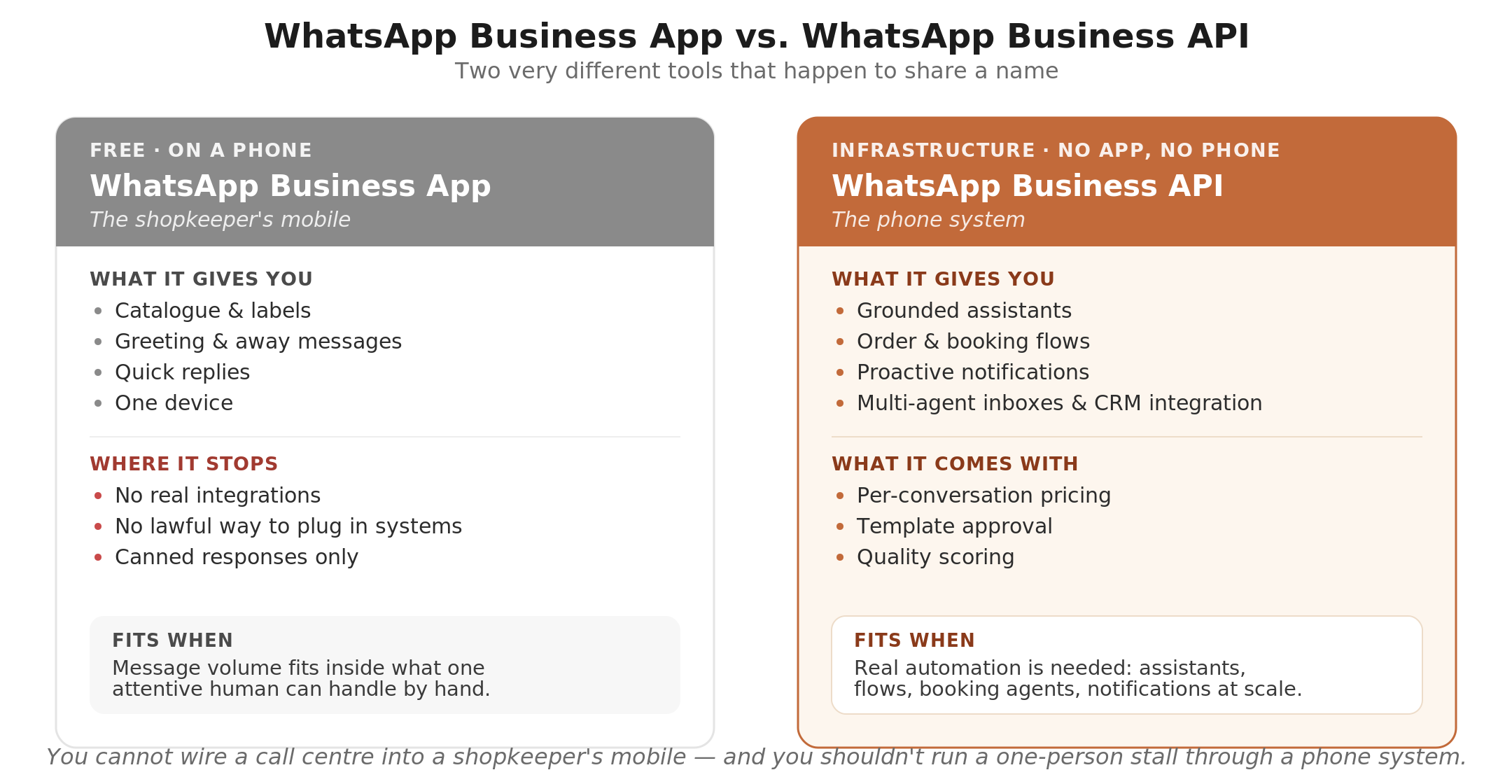
WhatsApp for business comes in two completely different products wearing one brand, and knowing which you are on decides what is possible.
The WhatsApp Business app (the free one on a phone). Built for micro-businesses: a catalogue, labels, greeting and away messages, quick replies. Its automation ceiling is exactly that list: canned responses, no real integrations, one device (with limited multi-device), and no lawful way to plug proper systems in. If your volume fits one attentive human, the app plus discipline is genuinely enough, and this guide's later tiers are not yet for you.
The WhatsApp Business API / Platform (the infrastructure). No app, no phone: a programmable channel accessed through Meta directly or via Business Solution Providers, designed for systems to send and receive. This is where real automation lives: grounded assistants, order flows, booking agents, proactive notifications, multi-agent inboxes, CRM integration. It comes with per-conversation pricing, template approval for business-initiated messages, and quality scoring that punishes spammy behaviour, all covered below.
The analogy: the app is a shopkeeper's mobile; the API is a phone system. You cannot wire a call centre into a shopkeeper's mobile, and you should not run a one-person stall through a phone system. Most businesses reading this guide are at the awkward in-between stage, which is precisely the migration this guide maps.
What Can Actually Be Automated on WhatsApp?
The [four jobs of automation], WhatsApp edition, in ascending order of ambition:
Instant answers from your real knowledge. A [grounded assistant] on your WhatsApp number: opening hours, prices, delivery areas, policies, product questions, answered from your actual documents with the "say when you don't know and hand off" instruction. This alone absorbs the repetitive majority of most WhatsApp inboxes, at any hour, in the customer's language.
Triage and routing. Every incoming message classified (order, booking, complaint, sales, chit-chat), urgent and angry ones routed to a human immediately with context attached, the rest queued or handled. The [triage-desk pattern], applied to the green icon.
Structured flows: bookings, orders, payments. WhatsApp's interactive messages (lists, buttons, forms) plus API integrations let whole transactions complete in-thread: pick a slot, confirm the order, receive the payment link, get the confirmation. This is where WhatsApp automation stops being deflection and starts being revenue: the appointment booked at 11pm that yesterday was a missed message.
Proactive notifications (the regulated kind). Order confirmations, delivery updates, appointment reminders, payment reminders: business-initiated messages using pre-approved templates. Done right, these are the highest-satisfaction messages a business sends; done wrong, they are the fastest route to a banned number, which is why the compliance section below is not optional reading.
The full agent. An [acting agent] on the channel: reads the request, checks your systems, resolves within boundaries, escalates the exceptions, with [approval gates] on anything consequential: refunds, changes over thresholds, anything legal-adjacent. Everything our [agents-vs-chatbots] and [governance] guides prescribe applies verbatim; WhatsApp is just the interface.
The Rules That Keep You Unbanned
WhatsApp automation has a regulator most channels lack: Meta's quality system, and it has teeth. The rules that matter, in plain English:
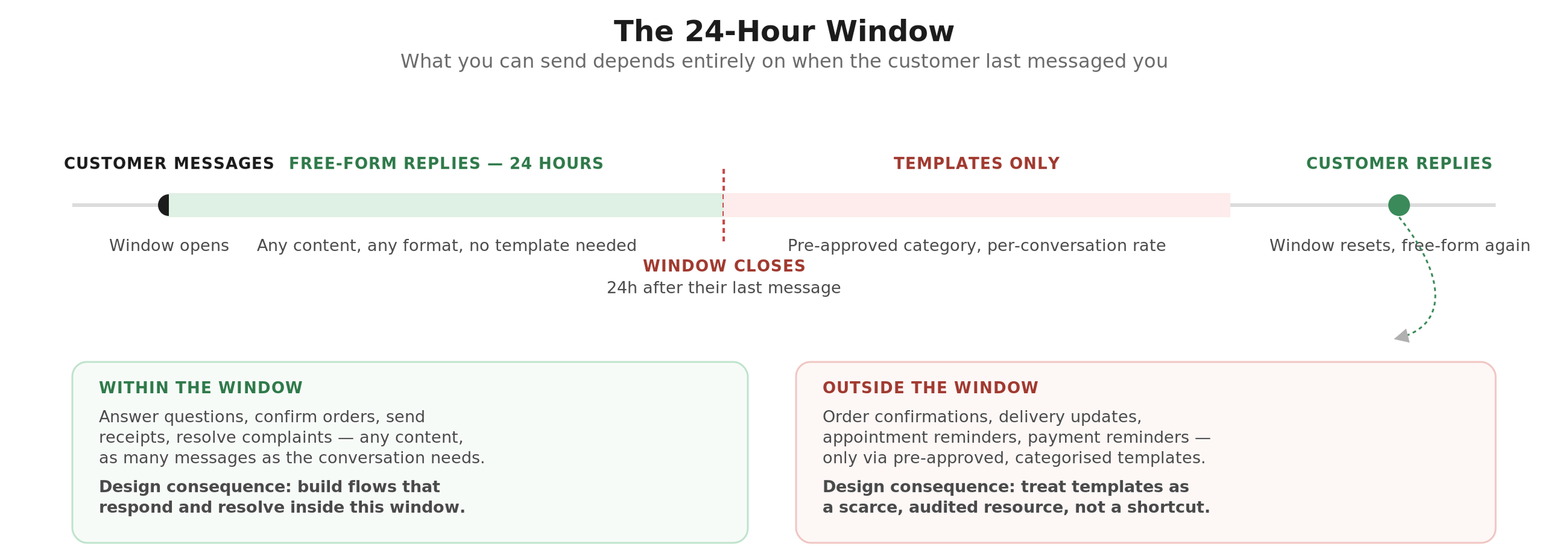
The 24-hour window. When a customer messages you, a service conversation opens: you may reply freely for 24 hours. Outside that window, business-initiated contact requires pre-approved message templates, in defined categories, at per-conversation rates. Design consequence: build flows that respond within windows, and treat templates as the scarce, audited resource they are.
Opt-in is real. Proactive messages require genuine consent, collected and recorded. Buying lists and blasting is not a growth hack on this channel; it is account suicide, sometimes within days.
Quality scores watch you. Block rates and reports feed a per-number quality rating; falling ratings throttle your messaging limits, and persistent abuse ends numbers. The practical translation: relevance discipline. Every proactive template should pass the test "would a reasonable customer thank us for this?": order updates yes, Tuesday promo blast to everyone, no.
Identity and honesty. Businesses must be who they say they are (business verification), and automated conversations should not impersonate humans: an assistant that introduces itself as one, with a human one message away, satisfies both the rules and the customers. (The [bouncer trap] applies doubly here: WhatsApp users expect person-speed humanity; trap them and the block button is one thumb away, feeding exactly the quality score that governs your number.)
None of this is onerous once designed in; all of it is expensive bolted on after a restriction. It is [governance], channel edition.
What Does WhatsApp Automation Cost?
Three layers, mapping to the [pricing tiers]:
Meta's per-conversation fees: varying by country and category, typically pennies-to-tens-of-pennies per conversation; service conversations (customer-initiated) cheapest, marketing templates dearest. At SMB volumes this is usually the smallest line.
Platform/BSP fees: the providers who wrap the API in usable tooling charge monthly subscriptions and sometimes per-message margins: from tens of pounds monthly for basic tiers to hundreds for full-featured inboxes with automation.
The build: a grounded WhatsApp assistant lands where grounded assistants land (£3,000-8,000 typical, tier 3 lower band); full booking/order agents with system integrations sit higher (£8,000-20,000), with connectivity of your booking/order/payment systems the usual swing factor. Running costs: platform fees plus model usage, typically £100-400 monthly at small-business volumes.
The ROI shape is unusually direct on this channel: missed WhatsApp messages are usually missed revenue (the unanswered 9pm booking enquiry books elsewhere by 9:15), so the [ROI maths] often clears on captured revenue alone before the recovered hours are counted.
A Real-World Shape
A 12-chair salon running entirely on WhatsApp: ~90 messages a day, one owner's thumb, bookings lost nightly after close. The build: migration to the API via a BSP; a grounded assistant answering services, prices and availability from the actual price list; a booking flow wired to the calendar (list message → slot pick → confirmation template); reminder templates (opted-in) the day before appointments; sentiment-and-keyword routing sending anything unhappy or complicated straight to the owner with history attached; and hard rules: no proactive marketing without explicit opt-in, refunds and complaints always human.
Ninety days later: 62% of conversations fully handled (bookings included), after-hours bookings up from zero to 11 a week, no-shows down 40% (the reminders), the owner's phone quiet at dinner for the first time in four years, and the number's quality rating green throughout, because the only proactive messages anyone received were ones they wanted. Build cost sat in the lower tier-3 band; payback, counted on captured bookings alone, arrived inside a quarter.
The 60-Day Path
Days 1-10: measure the thumb. Tally the inbox: volumes by hour, question types, missed/late replies, after-hours arrivals. This is the [baseline] and the business case in one.
Days 11-20: fix the knowledge, choose the plumbing. Update the price list, policies and FAQs the assistant will ground on ([readiness], channel edition). Choose API access via a reputable BSP; start business verification; draft the first template set (confirmations, reminders) for approval.
Days 21-40: assistant plus routing, shadowed. Launch the grounded assistant with the hand-off one message away, and routing rules for the urgent and unhappy. Owner reviews every conversation for a fortnight ([shadow discipline]); the misreads become knowledge-file fixes.
Days 41-60: the first flow, then the reckoning. Add the highest-value structured flow (bookings or orders), gates on anything consequential, opted-in reminders live. Day-60: compare to the tally: handled rate, captured after-hours revenue, response times, quality rating. Decide the next flow by the numbers, per [the roadmap] rhythm.
Choosing a BSP: The Five Checks
The Business Solution Provider (the company wrapping the API in usable tooling) is a real decision, because you will live inside their inbox, their automation builder and their pricing model. Five checks sort the market:
1. Pricing transparency. Meta's per-conversation fees should pass through visibly, with the BSP's margin stated, not blended into mystery. Blended pricing is where per-message costs quietly double.
2. Automation depth. Canned flows only, or real agent capability: grounding in your documents, API/webhook connections to your calendar and order systems, [approval gates]? Your 60-day plan's later stages depend on this answer; ask it before the free trial charms you.
3. Exportability. Your contacts, conversation history and templates: exportable, in standard formats, stated in the contract. WhatsApp numbers migrate between BSPs; your data should too, and [the documentation clause] logic applies verbatim.
4. Quality-rating tooling. Does their dashboard surface your number's quality rating, block rates and template performance, or do you discover problems when Meta throttles you? The good BSPs treat rating protection as a product feature.
5. Human-inbox ergonomics. Your team will handle the escalations inside this tool daily: routing, assignment, context visibility, the whispered history when a bot hands off. An hour's real trial with your actual team beats every feature matrix.
Regional note for Southeast Asian businesses: BSP quality varies sharply by market, and local presence matters for support hours and payment-method integrations (PayNow, local gateways). Shortlist providers with real customers in your country, then run the five checks.
Frequently Asked Questions
-
Only lightly: greeting and away messages, quick replies, catalogue. Real automation (grounded assistants, booking flows, integrations, notifications) requires the WhatsApp Business API via Meta or a Business Solution Provider. The app suits one-attentive-human volumes; the API is the phone system for everything beyond.
-
Automation is fully supported on the API, within the rules: reply-window discipline, pre-approved templates for business-initiated messages, genuine opt-in for proactive contact, honest bot identity, and a human hand-off. Bans come from spam behaviour (bought lists, irrelevant blasts, trapped customers), not from automation itself. Design the rules in and quality ratings stay green.
-
Three layers: Meta's per-conversation fees (pennies, usually the smallest line), platform/BSP subscriptions (tens to hundreds monthly), and the build: grounded assistants from roughly $3,000-8,000, full booking/order agents $8,000-20,000, running costs $100-400 monthly. On this channel the ROI often clears on captured after-hours revenue alone.
-
Yes: interactive messages (lists, buttons) plus API integrations complete whole transactions in-thread: slot selection against your real calendar, order confirmation, payment links, confirmations and reminders via templates. This transactional layer is where WhatsApp automation shifts from cost-saving to revenue-capturing.
-
No: it violates platform expectations, customer trust and increasingly the law in some jurisdictions, and it is unnecessary: customers accept obvious assistants that are instant, accurate and one message from a person. Introduce it honestly, ground it in your real knowledge, and keep the human hand-off shiny.
-
Complaints and anything emotionally loaded (route to humans with context: the empathy is the job), refunds and account changes beyond thresholds (gate them), legal-adjacent anything, and proactive marketing without recorded opt-in (the ban magnet). The [governance] rules apply to the green channel exactly as everywhere: the interface changed; the gates did not.
-
Yes, numbers migrate to the API (and between BSPs), with a defined porting process; plan for a brief transition window and export your chat history first, since app-era conversations do not carry into the API automatically. Many businesses run a short dual period: the API number live for automation while the app winds down.
-
Same brain, different room, and the room changes the rules: WhatsApp brings identity (you know the customer's number and history), notification rights (templates can reach out, website chat cannot), thumb-speed expectations, and Meta's quality regime. It is usually the higher-value deployment for businesses whose customers already live there, and the two share grounding and governance plumbing when built properly.
The Takeaway
WhatsApp is where your customers already are, which makes it the highest-yield automation surface most small businesses own, and the one with a real regulator watching. The playbook: get on the API, ground the assistant in your true prices and policies, wire the booking or order flow that captures the 11pm revenue, keep proactive contact opted-in and genuinely wanted, and leave complaints and empathy where they belong.
Do it in that order and the green icon stops being a leash and starts being a storefront that never closes, with your quality rating, and your dinner hours, intact.
Bots and Brand Works builds WhatsApp automation the quality-rating-safe way: grounded, gated, opted-in, human-one-message-away. Send us one week's message tally from your business number and we will tell you what it would capture, free.
Need help implementing an AI Solution?
Resources and Further Reading
Related: AI for Customer Service
Related: AI Agents vs Chatbots
WhatsApp Business Platform documentation: Click Here Click Here Click Here
[Vector Databases and RAG] · [AI Agent Governance] · Human Approval