

What Is an LLM? Large Language Models Explained for Business Owners
LLMs power every AI tool you have heard of, and almost nobody explains them properly. What a large language model actually is, how it works, why it makes things up, and how businesses should choose and use one.
Every AI tool you have heard of in the last three years (ChatGPT, Claude, Gemini, the chatbot on your bank's website, the assistant in your CRM) runs on the same class of technology: a large language model, or LLM. It is the engine inside all of it, the "brain" layer of every [AI automation stack], and the single most consequential piece of software of the decade.
It is also almost never explained properly to the people signing the cheques. Explanations come in two unhelpful flavours: the mystical ("it's like a digital mind") and the dismissive ("it's just autocomplete"), and both lead to bad business decisions: the mystical version makes people trust it too much, the dismissive one makes them trust it too little.
So here is the proper explanation, in plain English: what an LLM actually is, how it does what it does, why it fails the specific ways it fails, and the practical decisions (which model, what tier, what safeguards) that follow directly from understanding the machine. No maths, one running analogy, and by the end, the behaviour of every AI tool you use will make noticeably more sense.
What Is a Large Language Model?
An LLM is a computer program that has processed a colossal amount of text (books, articles, websites, code: a meaningful slice of everything humans have written) and, from all that reading, learned the patterns of how language works: which words follow which, how ideas connect, how arguments are structured, how a refund email differs from a poem.
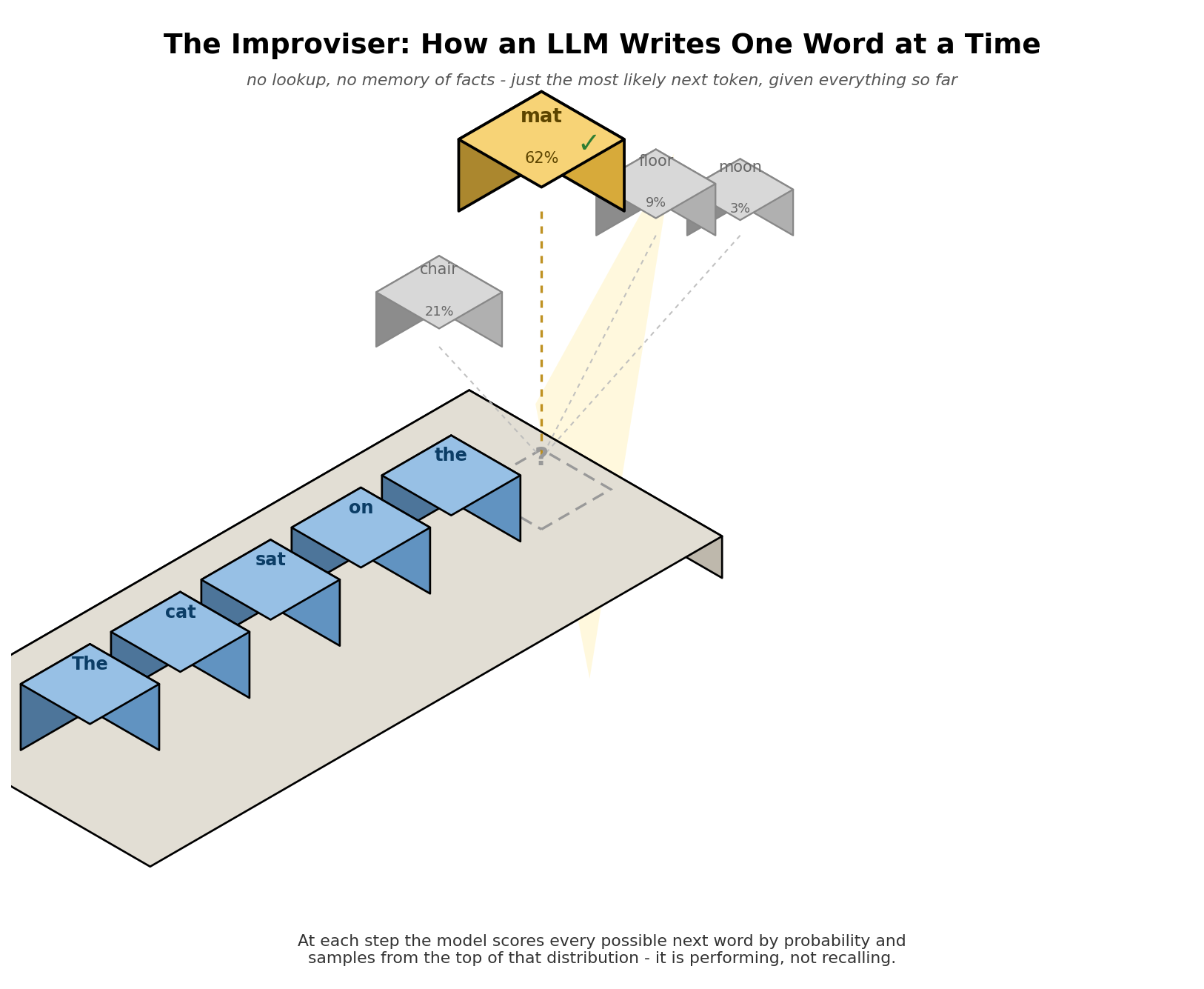
What it does with those patterns is deceptively simple to state: given some text, it predicts what should come next, one small piece at a time, over and over, until it has produced a reply, an essay, a summary or a plan.
The analogy that carries the article: an LLM is the world's most well-read improviser. Imagine someone who has read essentially everything (every textbook, manual, contract, novel and forum thread) but memorised almost none of it verbatim. Instead they absorbed the patterns: how explanations go, how legal language sounds, what usually follows "the three main causes were...". Put them on stage with any prompt and they improvise fluent, informed, usually-accurate continuations, drawing on the shape of everything they ever read. Brilliant, fast, endlessly versatile. And, crucially: improvising, always, even when they sound like they are reciting.
That last sentence explains more about LLM behaviour than any other, so keep the improviser in mind as we go.
How Does an LLM Actually Work? The Five-Minute Version
Training: the reading years. Before you ever meet it, the model is trained: shown billions of text passages and adjusted, tiny step by tiny step, until its predictions of "what comes next" get astonishingly good. This is the expensive part (months of computing, costs in the millions), which is why a handful of companies (Anthropic, OpenAI, Google and peers) train the big models and everyone else rents access. Training also has an end date, which is why a model's knowledge of the world has a cutoff and it knows nothing about last month.
Tokens: the pieces it thinks in. Models read and write in tokens: chunks of a few characters, roughly three-quarters of a word on average. This matters commercially because usage is priced per token, in and out: the meter behind every "AI usage" line on your invoices, and the reason long documents and long answers cost more.
Inference: the improvisation. When you type a prompt, the model does its one trick at speed: predict the next token, append it, predict again, thousands of times a second. There is no database lookup, no fact-checking pass, no "searching its memory": just extraordinarily informed pattern-completion. When the pattern it completes matches reality (which, for well-trodden subjects, is remarkably often), you get a correct answer. The fluency and the correctness come from the same mechanism, which is exactly why the failures look the way they do.
The context window: the desk. The model can only consider so much text at once: your prompt, the conversation so far, any documents supplied. That workspace is the context window, and it is the "notepad" our Agent Memory article builds on: big (hundreds of pages in modern models), but finite, and empty again next session unless something refills it.
Why Do LLMs Make Things Up?
Now the question every business owner eventually asks, answered by the machinery itself.
The improviser has no internal distinction between "completing a pattern from things I read" and "completing a pattern plausibly." Ask about a well-documented topic and the pattern-completion lands on truth. Ask about your company's delivery policy (which it never read) and the very same mechanism produces a fluent, confident, plausible delivery policy: the shape of a thousand real ones, the content of none. The industry calls this hallucination; mechanically, it is the model doing exactly what it always does, on a subject where the pattern has no anchor.
Three business consequences follow directly:
Confidence is not evidence. The model sounds identical when right and when wrong, because the same process produced both. Tone tells you nothing; sources do.
Grounding is the fix, and it works with the machine, not against it. Put the actual delivery policy on the desk (the context window) and the improviser completes from what is in front of it rather than from vibes. That is the entire logic of [RAG and vector databases]: retrieval fills the desk with your real documents, and accuracy follows. It also explains why grounding beats "training the AI on your data" for facts: fresh pages on the desk, versus hoping the reading years absorbed your price list.
Checking is a design layer, not an afterthought. Since improvisation cannot self-certify, reliable systems verify: mechanical checks where facts are testable, [reflection] passes where they are not, and humans at the consequential gates. Every safeguard in our agent series exists because of this one property of the engine.
What Are LLMs Genuinely Good At (and Not)?
Superb at: transforming language (summarise, rewrite, translate, change tone), drafting from patterns (emails, descriptions, plans, code), extracting structure from mess (pull the fields out of this invoice), reasoning through problems step by step, and powering the judgment layer of [agentic systems] when wrapped with tools and memory.
Unreliable at: precise arithmetic (it patterns numbers rather than calculating; give it a calculator tool), current events past its training cutoff (give it search), your private facts (give it retrieval), and long-horizon consistency without the memory scaffolding our anatomy series describes.
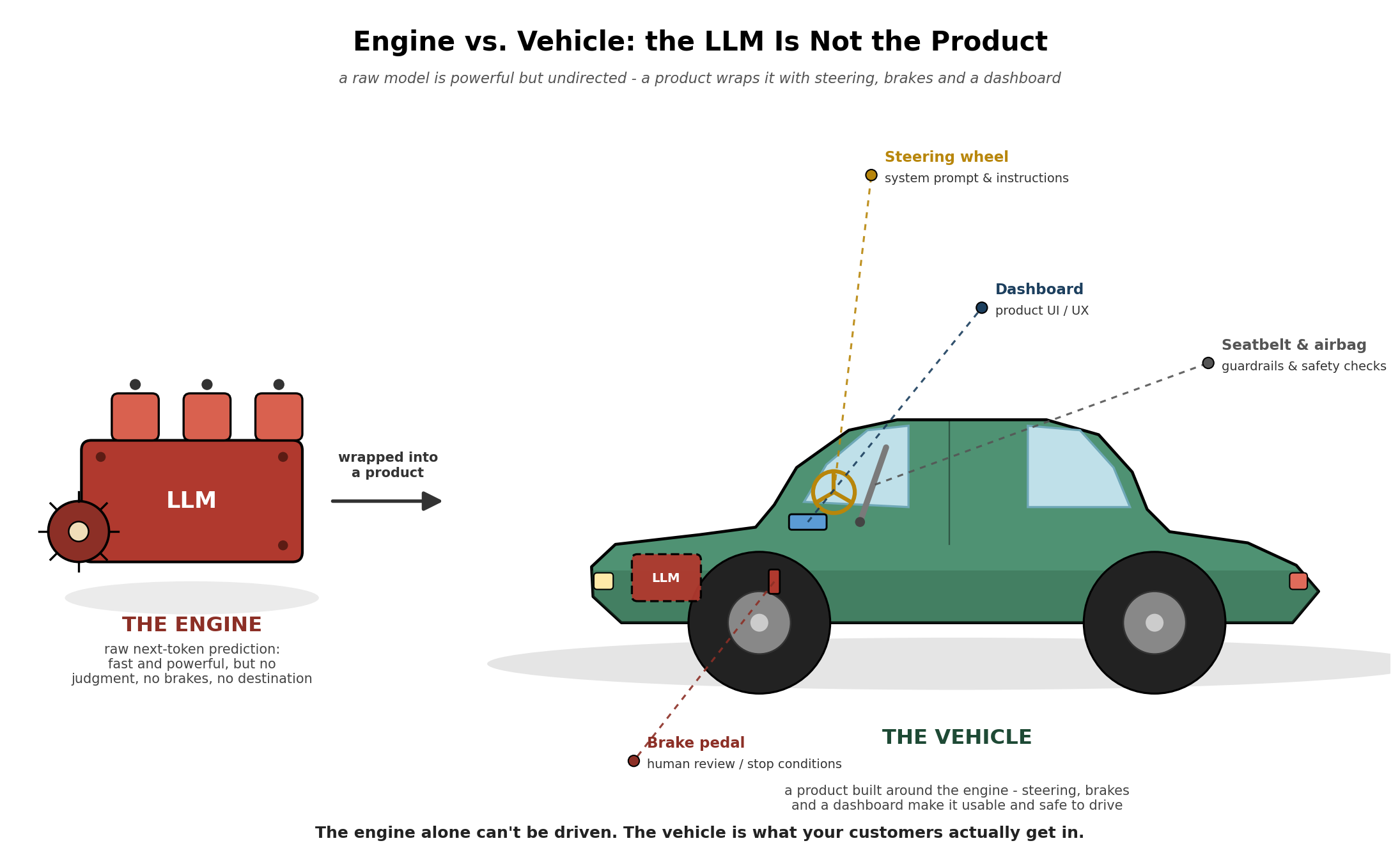
The design rule that falls out: LLMs are engines, not vehicles. Nobody hands a customer a bare engine; you build around it: tools for what it cannot do, grounding for what it cannot know, checks for what it cannot certify, gates for what it must not decide alone. Every disappointing AI deployment we audit turns out to be a bare engine; every excellent one is a vehicle.
Choosing Models: Tiers, Routing and the Only Questions That Matter
The market offers dozens of models, refreshed quarterly. Ignore the churn; the buyer's map is stable:
Frontier tier. The strongest reasoning (Claude's top models, GPT's top models, Gemini's top models): best judgment, highest per-token price. Belongs on the steps that need it: complex synthesis, delicate customer replies, planning.
Workhorse tier. Fast, cheap, very capable mid-range models: perfect for classification, extraction, routine drafting, high-volume steps. Most of a well-built system's token volume should run here.
Local and open-weight models. Runnable on your own hardware: relevant when data cannot leave your infrastructure, at the cost of capability and self-maintenance. A niche, but a real one for regulated businesses.
The professional pattern is routing: cheap models for cheap steps, frontier models for judgment moments, exactly as a firm staffs juniors and seniors ([the anatomy article]'s head-chef-and-prep-cooks point). When evaluating any AI product or build, the two questions that matter are not "which model?" but: is the model grounded in our data where facts matter, and can the model be swapped when better ones arrive? Model-agnostic builds (standard APIs, MCP-based tools) turn the quarterly model churn from a risk into a free upgrade stream.
What About Our Data? The Two-Sentence Privacy Section
Business-tier access to major LLM providers comes with terms that do not train on your data, and your documents used for grounding are consulted at question time, not absorbed ([the RAG article] unpacks this). The questions to ask any provider are where data lives, whether it trains anything, and retention periods; reputable ones answer in one sentence each, and the [governance guide] covers the rest.
The Buyer's Glossary: Eight Terms That Now Make Sense
With the improviser in mind, the vocabulary of every AI meeting decodes itself. Keep this list for the next vendor call.
Prompt. Whatever text you put in front of the improviser: the question, the instructions, the documents. Prompt quality is briefing quality, which is why the same model performs differently for different teams.
System prompt. The standing instructions the improviser reads before every conversation: tone, rules, boundaries, "say when you don't know." Cheap to change, powerful in effect, and the first place to look when behaviour needs adjusting.
Token. The unit of reading and writing, roughly three-quarters of a word, and the unit of billing. "Token costs" means usage costs.
Context window. The desk: everything the model can consider at once. "It won't fit in context" means the desk is full and something must be summarised, split or retrieved on demand instead.
Fine-tuning. Sending the improviser back for targeted re-training: right for teaching style and format, wrong for teaching your facts (that is grounding's job). Expensive, occasionally justified, frequently oversold.
Grounding / RAG. Putting your real documents on the desk before the improvisation starts, so answers come from your pages, with citations. The reliability upgrade behind every trustworthy business deployment.
Temperature. A dial for how adventurous the improviser is: low for consistency (extraction, policy answers), higher for variety (creative drafts). If outputs feel erratic, ask what the dial is set to.
Inference. The industry word for the model actually running: the improvisation itself, as opposed to training (the reading years). "Inference costs" is another name for the usage meter.
Eight terms, one metaphor, and most AI meetings stop being foreign-language events.
Frequently Asked Questions
What does LLM stand for and what is it in simple terms? Large Language Model: a program trained on a vast amount of text until it can predict, fluently and usually accurately, what text should come next. Practically: the world's most well-read improviser, powering every modern AI assistant, chatbot and agent as their reasoning engine.
Is ChatGPT an LLM? ChatGPT is a product built around one (the GPT family of models), as Claude is built around Anthropic's models. The distinction matters commercially: products add interfaces, tools and memory around the engine, and the same engines are available via API for your own systems, which is how custom automations are built.
Why do LLMs hallucinate and can it be stopped? Because generating truth and generating plausibility are the same mechanical act for a model: on subjects it has no anchor for, the fluent pattern-completion continues anyway. It cannot be switched off, but it is managed to near-irrelevance in good systems: grounding in your real documents, instructions to admit ignorance, mechanical checks, and human gates on the consequential.
Do LLMs learn from my conversations? The model itself does not change as you use it; within a conversation it "remembers" only what is in the context window. Whether a provider uses your data to train future models is a contractual matter: business tiers of reputable providers do not. Persistent memory in products is engineering around the model, per our [Agent Memory] guide.
Which LLM is best for business use? The honest answer: it changes quarterly and matters less than the architecture. Choose by tier (frontier for judgment, workhorse for volume), demand grounding in your data, and build model-agnostic so upgrades are swaps rather than rebuilds. Any vendor whose pitch is a model name rather than a system design is selling the engine, not the vehicle.
How much does using an LLM cost? Consumer subscriptions run tens of pounds monthly; API usage is metered per token, from pennies per typical task on workhorse models to more on frontier tiers. In automations, model usage is usually a minor line next to build and integration costs, but it scales with success, so monitoring belongs in every deployment (see [How Much Does AI Automation Cost?]).
What is a context window? The model's working desk: the maximum text it can consider at once, covering your prompt, the conversation and any supplied documents. Modern windows hold hundreds of pages, but they are finite and reset between sessions, which is why persistent memory and retrieval are built around the model rather than assumed inside it.
The Takeaway
An LLM is the well-read improviser: patterns from everything, recall of nothing, fluent always, correct usually, and never aware of the difference. That single picture explains the magic (the drafting, the reasoning, the versatility) and the failure modes (the confident invention, the arithmetic wobbles, the amnesia) in one frame.
The business conclusion is equally compact: buy the engine wisely (tiers, routing, swappability), but invest in the vehicle: grounding for truth, tools for capability, checks for reliability, and humans at the gates. The engine is rented and improving quarterly. The vehicle is yours, and it is where every pound of advantage actually lives.
Bots and Brand Works builds vehicles, not bare engines: grounded, routed, checked and gated systems on whichever models currently earn their seat. If an AI tool has been confidently wrong about your business, send us the example and we will show you which part of the vehicle was missing.
Need Help Implementing AI?
Resources and Further Reading
- The AI Automation Stack Explained [add internal link]
- Related: What Is Agentic AI?
- Related: [Vector Databases and RAG Explained]
- Also useful: Agentic AI vs Workflow Automation · Agent Memory Explained
- Anthropic model documentation: Click Here · OpenAI models: Click Here
- Anthropic: Building effective agents: Click Here