

Salespeople spend most of their week not selling. How AI fixes that: lead scoring, call intelligence, CRM automation and research at machine speed, with a 90-day plan and the sincerity trap to avoid.
Get the free Outreach Rulebook
Ask any salesperson what they were hired to do and they will say: talk to buyers. Then watch their actual week: researching prospects, updating the CRM, writing follow-ups, chasing silence, assembling proposals, and apologising to the pipeline report. Study after study finds sellers spending well under half their time actually selling, and every sales leader reading this just nodded.
That gap between the job and the admin around the job is AI's natural habitat in sales. Not robot sellers, not automated charm, but removing everything that stands between your team and a conversation with a buyer. This guide covers how: the three roles AI plays in a sales function, the use cases that move revenue, the trap that makes AI outreach worse than none, and a 90-day plan to get the selling time back.
(This deep dive expands the sales chapter of [AI for Every Business Function], using the same assistant-analyst-agent lens.)
What Does AI Actually Do in Sales?
The assistant: research and writing at machine speed. Before a call, it assembles the brief: company news, likely pain points, mutual connections, what changed since last contact. After the call, it drafts the follow-up and the proposal skeleton from the notes. Between calls, it writes outreach that starts from something true about the prospect instead of "I hope this email finds you well."
The analyst: prioritisation. It scores leads by real signals (engagement, fit, timing, behaviour) so the team calls the five most likely buyers first instead of working the list alphabetically. It reads across every call and deal to find the patterns no manager has time to hear: which objections precede lost deals, which talk tracks precede won ones, where deals stall.
The agent: the CRM that updates itself. Emails, meetings and call notes flow into the CRM automatically: contacts created, deals moved, next steps logged. This one deserves its own applause line, because it fixes the oldest lie in sales: the pipeline report that reflects what reps remembered to type, not what is actually happening.
The analogy: AI gives every rep the support team that only the top biller at a big firm used to get: a researcher who preps every meeting, an analyst who says who to call first, and an assistant who does the paperwork. The rep still does the only part that ever closed a deal: the human conversation. Everyone gets the entourage; the selling stays theirs.
Read more about: WhatsApp Business Automation
Why Should a Business Care?
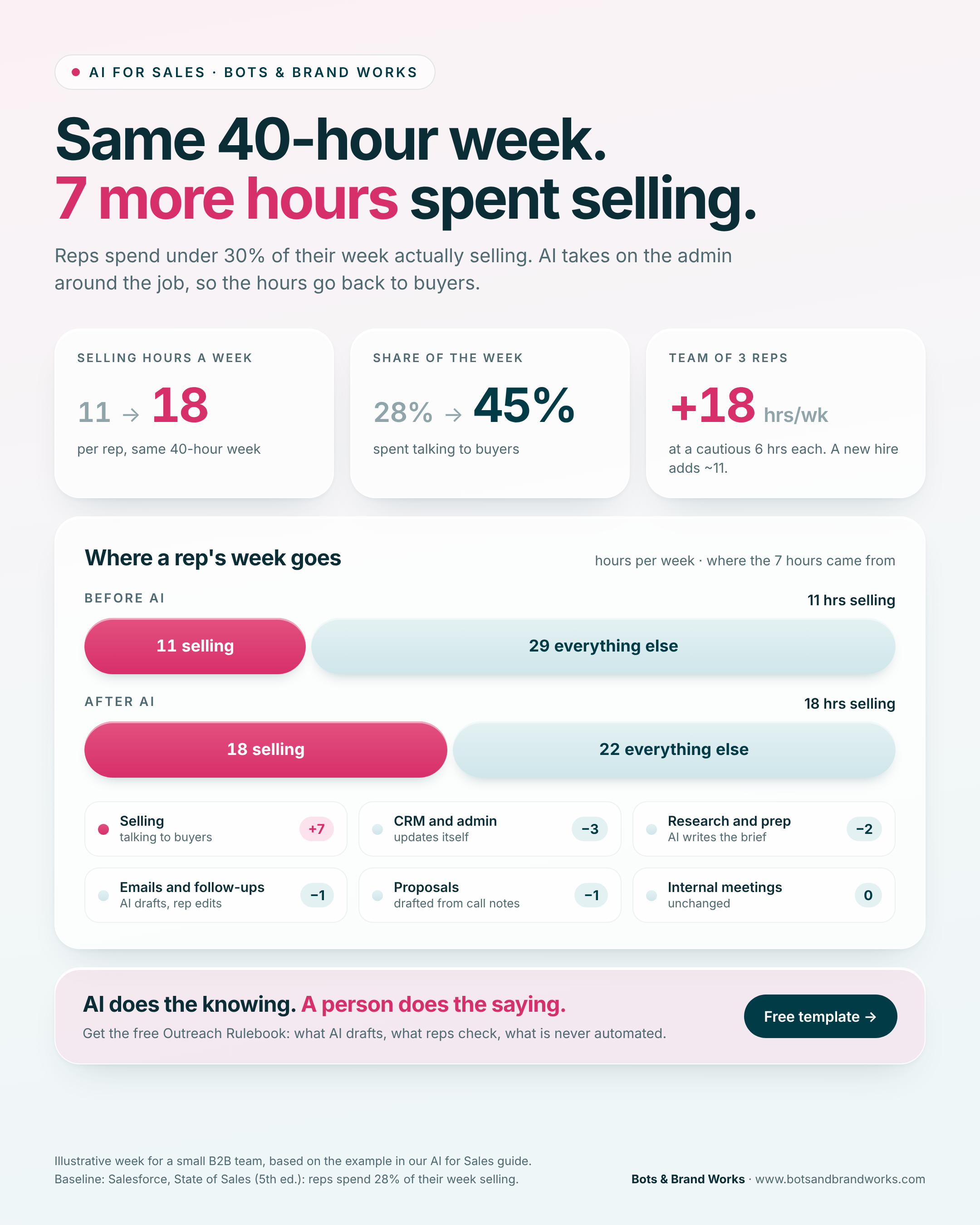
Because selling time is the whole ballgame. If your three reps each gain back six hours a week from admin, you have hired most of a fourth rep for the price of software. No other sales investment (training, tools, incentives) reliably creates capacity this cheaply.
Because speed wins deals you never knew you lost. Inbound leads contacted within minutes convert at multiples of those contacted next day. An agent that triages, enriches and routes every enquiry instantly, and drafts the first response for approval, is the difference between "we got back to them Tuesday" and being first in the door.
Because your pipeline finally tells the truth. Forecasts built on self-reported CRM hygiene are folklore. When the CRM updates itself from actual emails and calls, the Monday pipeline meeting starts from reality, and coaching starts from what was actually said on calls rather than what reps recall saying.
The Use Cases Earning Their Keep
Lead scoring and routing. The analyst ranks inbound and outbound lists by likelihood and urgency, with reasons attached ("visited pricing twice, hiring for the role your product serves"). Teams that adopt this stop debating who to call and start calling.
Call intelligence. Transcribe and summarise every sales call, extract commitments and next steps automatically, and mine the library for patterns: "we lose when pricing comes up before the demo" is worth a quarter of training, and no human can listen to a hundred calls to find it.
CRM automation. Contacts, activities and deal stages maintained from real communication. Reps hate data entry; buyers never see it; automating it is pure recovered selling time with zero customer risk. The perfect first agent by every rule in [Why AI Projects Fail].
Personalised outreach, done right. Research-grounded first lines and relevant follow-ups, drafted by AI, reviewed by the rep. The operative word is reviewed; more on the trap below.
Proposal assembly. First drafts built from the call notes, your past proposals and your pricing rules, so reps edit for an hour instead of assembling for four. (Approval stays human; anything with prices on it should, per our [governance guide].)
The Tool Categories Worth Knowing
Meeting intelligence (recorder-summarisers, now built into most meeting platforms): the fastest win in the whole function.
CRM-native AI: your existing CRM's scoring, summaries and automation features, already paid for. Switch on before buying anything.
Enrichment and research layers that fill in who a prospect is and what changed.
Sales engagement platforms with AI sequencing, once volume justifies process.
(Later) custom agents for triage, routing and CRM maintenance when off-the-shelf stops fitting; the [pricing tiers] apply.
What Are the Limitations and Traps?
The automated sincerity trap, the big one. Buyers now receive dozens of AI-personalised emails a week and can smell them. "I saw your recent LinkedIn post about scaling" from a stranger is not personalisation; it is a template wearing your name. Badly automated outreach does not just fail; it burns the brand with every send, at scale. The rule that holds: AI to know the prospect better, a human to decide what is worth saying. Research at machine scale, relationships at human scale.
Scoring is not destiny. Lead scores are probabilities, not verdicts. A team that refuses to call anything below 80 will miss the odd whale that scored 40 for data reasons. Scores order the work; they do not excuse skipping it.
Garbage CRM in, garbage analyst out. If years of CRM data are chaos, the analyst learns chaos. A cleanup pass (dedupe, dead-deal purge, field standards) is unglamorous and pays for every AI initiative that follows.
Recording needs consent. Call intelligence means recording calls: consent rules vary by region and buyer expectations vary by market. Announce it, make it normal, and check your jurisdiction's rules once with someone qualified.
The pipeline is not a slot machine. Agent-level automation (auto-sequences, auto-routing) touching real buyers needs the same boundaries as any agent: caps, review, and a human gate on anything a buyer will read. The full mechanics are in [AI Agent Governance].
How Does It Compare? Three Ways to Buy Sales AI
The same capabilities arrive in three packages, and the right one depends on team size and volume.
Built-in features (your CRM and meeting tools). Nearly free, instantly on, and covering more ground each quarter: summaries, drafting, basic scoring. The right starting point for every team, and the finish line for many under five sellers. Limit: everything happens inside one vendor's walls, on their roadmap.
Point tools (enrichment, engagement, call intelligence platforms). Deeper capability per job, typically $20 to $100 per user per month each. The trap is stack sprawl: three point tools that do not talk to each other or to the CRM recreate the very admin you were removing. Rule: every point tool must write back to the CRM automatically or it does not get bought.
Custom automations. The triage agent, the CRM-maintenance agent, anything stitched precisely to your process. Low thousands to build (the [pricing guide] tiers apply) and justified when volume is real and the off-the-shelf shapes do not fit. Prototype the logic cheaply on a platform first, per the sequencing our pillar guide proves out.
And the scoreboard that keeps all three honest. Track four numbers monthly against your pre-AI baseline: selling hours per rep per week (the headline), inbound response time, pipeline accuracy (forecast vs actual, which improves as the CRM starts telling the truth), and revenue per rep. Adoption metrics (summaries generated, drafts used) are fine for week one and meaningless by month three; the four business numbers are the only ones that justify the spend. If selling hours are not visibly rising within a quarter, the stack is decorating the process rather than clearing it, and the audit starts with whichever tool is not writing back to the CRM.
A Real-World Shape
An eight-person B2B firm, three sellers, one perpetual complaint: "no time to prospect." The setup: meeting intelligence on every call, CRM-native AI switched on, an enrichment layer, and one custom automation that triages inbound enquiries, enriches them, scores them and drafts a first reply for approval within minutes.
One quarter later: reps report roughly seven hours a week back (the CRM types itself, proposals start 80% assembled), inbound response time fell from hours to minutes, and the call library surfaced one uncomfortable, valuable pattern: their most talkative rep was also their least effective discovery questioner. Revenue per rep rose 18%, and the pipeline meeting stopped opening with apologies.
How Do I Implement AI for Sales? The 90-Day Plan
Days 1 to 15: switch on and clean up. Enable meeting intelligence and your CRM's AI features. Run the CRM cleanup: duplicates, dead deals, field standards. Write the one-page outreach rulebook: what AI drafts, what humans must review, what is never automated.
Days 16 to 45: the assistant layer. Every call gets an AI brief before and an AI summary after, flowing into the CRM. Reps adopt the research-then-human-edit outreach pattern. Measure the baseline honestly: hours on admin, response times, calls per week ([the ROI guide] shows the counting method).
Days 46 to 75: the analyst layer. Turn on lead scoring against your cleaned data; reorder the team's day around it. Run the first call-library mining session: what do won deals have in common? Feed the findings into training, not blame.
Days 76 to 90: the first agent, gated. Automate inbound triage-enrich-score-draft with human approval on every send. Compare the quarter to baseline. Decide the next automation by the numbers, and graduate anything customer-facing through the [governance checklist] first.
Frequently Asked Questions
-
It ranks prospects by fit and behaviour signals so you contact the likeliest buyers first. It works at SMB scale provided your CRM data is clean and you have some history to learn from; with tiny lists, the enrichment and research layer matters more than the scoring itself.
-
Unedited, yes, increasingly: buyers recognise templated AI sincerity instantly. AI-researched, human-edited outreach outperforms both pure automation and unresearched human email. The winning division of labour: machine does the knowing, human does the saying.
-
Yes, and it is the highest-value, lowest-risk sales automation available: contacts, activities, summaries and next steps maintained from real emails and calls. Buyers never see it, reps stop hating Mondays, and your forecast starts describing reality.
-
Generally yes with appropriate consent, which varies by jurisdiction (one-party vs all-party consent rules). Announce recording, normalise it, and confirm your local rules once. The coaching and CRM value comfortably justifies the small process change.
-
Start near zero: meeting intelligence and CRM AI features you likely already pay for, plus an assistant subscription. The first custom automation (inbound triage) lands in the low thousands. Full tiers in [How Much Does AI Automation Cost?]; let recovered selling hours drive the maths.
-
It replaces the parts of the job salespeople hate and buyers never valued: the admin, the retyping, the assembly. The conversation, the trust, the judgment about what this buyer actually needs: those get more decisive, not less, when everyone's admin is automated. Hire sellers who sell; let the machine do the entourage work.
-
Adoption follows selfishness, in the good sense: lead with the features that give reps their evenings back (auto-updated CRM, pre-written follow-ups, prepped briefs) rather than the ones that help management (scoring, forecasting). When the first rep realises the CRM typed itself, adoption spreads without a mandate. Dashboards and league tables of "AI usage" achieve the opposite; recovered hours achieve everything.
-
Yes, and the improvement comes from two directions at once: the analyst reads deal signals (engagement, stage velocity, stakeholder breadth) rather than rep optimism, and the self-updating CRM feeds it truth instead of memory. Expect forecasts with confidence ranges rather than single numbers, and expect the first honest forecast to be uncomfortably different from the incumbent one. That discomfort is the value arriving.
The Takeaway
Bots and Brand Works builds sales AI setups for small teams: from switching on what you already pay for to custom triage agents with proper guardrails. Send us your team size and CRM, and we will estimate the selling hours you are leaving on the table. .
Need Help Implementing AI?
Resources and Further Reading
AI for Every Business Function
Related: AI for Marketing
Related: AI for Customer Service
Also useful: AI Agent Governance · How to Calculate AI Automation ROI